Toyota bZ4X Robotaxi Goes Fully Driverless in Guangzhou With Pony.ai
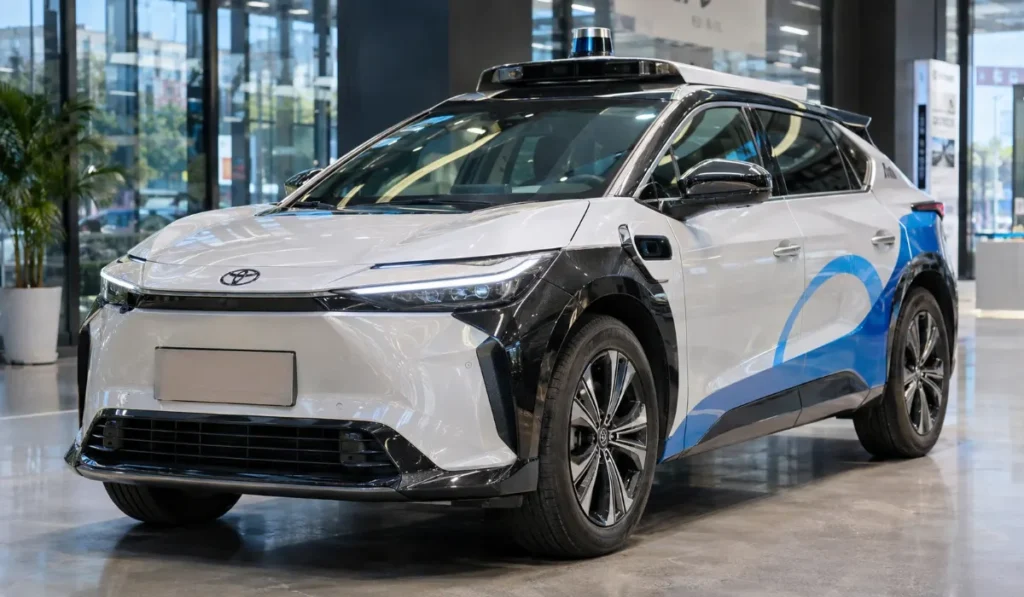
Toyota bZ4X Robotaxi rides are now open to the public in Guangzhou with nobody in the driver’s seat, after Pony.ai and Toyota announced fully driverless commercial service for the electric SUV. Passengers can hail it 24 hours a day through the PonyPilot app or Pony.ai’s mini-programs on WeChat and Alipay.
The joint announcement went out on PR Newswire at 23:00 ET on 15 November, which was 9:30 AM IST on 16 November 2026. It moves a car that first came off the production line in February into paid, driverless service, and it gives Toyota a working robotaxi on public roads in the world’s biggest EV market.
What is the Toyota bZ4X Robotaxi?
The Toyota bZ4X Robotaxi is a version of Toyota’s bZ4X electric SUV developed with Pony.ai for Level 4 driverless operation. It is one of Pony.ai’s three seventh-generation robotaxi models, and the companies say it was engineered from the start with redundant, fail-operational systems so it can run without a safety driver.
The partnership dates back to 2019. In 2023, Pony.ai, Toyota Motor China and GAC Toyota agreed to set up a joint venture with more than RMB 1 billion of investment to speed up robotaxi production. That is about EUR 135.6 million, or USD 149.9 million, at the ECB reference rates of 13 November 2026.
Pony.ai supplies the self-driving system and fleet know-how. Toyota brings vehicle engineering, manufacturing and, importantly, its service network for maintenance, charging and routine fleet care.
| Key fact | Detail |
|---|---|
| Announced | 15 Nov 2026, 23:00 ET (16 Nov, 9:30 AM IST) |
| Partners | Pony.ai and Toyota (built with Toyota Motor China and GAC Toyota) |
| Service city | Guangzhou, China |
| Autonomy | Level 4, fully driverless commercial service |
| Hours | 24 hours a day |
| Booking | PonyPilot app, WeChat and Alipay mini-programs |
| Planned fleet | About 1,000 bZ4X Robotaxis across major Chinese cities |
| First mass-produced car | February 2026 |
Where can you ride the bZ4X Robotaxi now?
For now, only in Guangzhou. Pony.ai says the bZ4X Robotaxi has joined its fully driverless commercial fleet in the city and runs around the clock. The companies are testing the model in other major Chinese cities and preparing to deploy it there, but they have not named those cities or given dates.
Booking is simple for anyone already using Chinese payment apps, because the car appears inside the WeChat and Alipay mini-programs as well as in PonyPilot. Earlier Pony.ai and Toyota robotaxi generations have already served Beijing, Shanghai, Guangzhou and Shenzhen, so those cities look like the natural next step. That is our reading, though, not a confirmed plan for this model.
What is new in the Gen-7 bZ4X Robotaxi?
Pony.ai lists Bluetooth unlocking, an intelligent voice assistant, in-car entertainment and personal climate controls. It also says software refinements give smoother acceleration, braking and cornering. The release does not include sensor counts, battery size or driving range for the robotaxi version, so those remain unknown.
That gap matters. A robotaxi carries extra computers, sensors and backup systems, which add weight and draw power. Until Pony.ai or Toyota publish technical data, we are not borrowing the road car’s range figures for the driverless bZ4X, because they may not apply.
How big is Pony.ai’s robotaxi fleet?
Pony.ai’s latest published figure is 1,975 robotaxis, reported with its second-quarter 2026 results on 18 August, and it is aiming for more than 3,500 by the end of 2026. About 1,000 bZ4X Robotaxis are planned for China. Third-quarter results, due on 18 November, should bring a fresh count.
The bZ4X joins two other Gen-7 models, BAIC’s Arcfox Alpha T5 and GAC’s second-generation Aion V, which Pony.ai said in February were already carrying riders in Beijing, Guangzhou and Shenzhen. Outside China, Pony.ai announced an expanded Uber deal in August to deploy more than 2,000 robotaxis across five European cities, and it started fully driverless test rides in Zagreb with Verne in September.
| Pony.ai milestone | Figure | Source and date |
|---|---|---|
| Robotaxi fleet | 1,975 vehicles | Q2 results, 18 Aug 2026 |
| Year-end fleet target | More than 3,500 | Q2 results, 18 Aug 2026 |
| Planned bZ4X Robotaxis | About 1,000 | Launch release, 15 Nov 2026 |
| Gen-7 models | 3 (bZ4X, Arcfox Alpha T5, Aion V) | Pony.ai releases, Feb and Nov 2026 |
| Uber Europe plan | More than 2,000 cars, 5 cities | Pony.ai release, 14 Aug 2026 |
How does it compare with Waymo, Tesla and other robotaxis?
Toyota is now on two robotaxi tracks at once. In China it builds the bZ4X Robotaxi with Pony.ai, while Waymo is working with Toyota on a separate programme. Tesla takes a different route, using its own software and a purpose-built Cybercab. The common thread is that Level 4 service, not driver assistance, is the target.
Our Waymo and Toyota bZ4X robotaxi report covers that second partnership, which plans testing in Japan in 2027. Tesla, by contrast, keeps everything in-house, from its Tesla robotaxi launch in San Antonio to the Tesla Cybercab orders at $29,990 plus a monthly plan.
Other Chinese carmakers are moving too, and Chery’s L4 robotaxi plans raise the same safety questions any driverless fleet must answer. It is also worth separating this from the supervised systems sold to private owners, such as Tesla Assisted Driving in Europe or Rivian’s point-to-point driving beta, where a human must still watch the road.
What is confirmed about the bZ4X Robotaxi, and what is not?
Pony.ai and Toyota have confirmed fully driverless paid service in Guangzhou, 24-hour availability, app access through PonyPilot, WeChat and Alipay, and a plan for about 1,000 cars in China. They have not confirmed the next cities, launch dates elsewhere, fares, range, battery size or sensor specifications.
| Claim | Status |
|---|---|
| Fully driverless commercial service in Guangzhou | Confirmed by Pony.ai and Toyota |
| Available 24 hours a day via PonyPilot, WeChat, Alipay | Confirmed |
| Around 1,000 bZ4X Robotaxis planned across China | Confirmed as a plan, no timetable |
| Testing in other major Chinese cities | Confirmed, cities not named |
| Fares, range, battery and sensor specs | Not published |
| Service outside China for this model | Not announced |
CarBike Insight Analysis
Our calculations, based only on Pony.ai’s published numbers, show how important this car is to the company’s plan. The planned 1,000 bZ4X Robotaxis equal about 51% of the 1,975-vehicle fleet Pony.ai reported at the end of June, and about 29% of its 3,500 year-end target.
To reach that target from mid-year, Pony.ai needed to add about 1,525 vehicles in the second half of 2026, roughly 254 a month. The third-quarter figures on 18 November will show how close it is. The gap between the first production car in February and paid driverless service in November is about nine months, which is quick for a new vehicle and a new safety case.
The split of roles is also telling. Toyota is not trying to write the driving software itself in China. It supplies the car, the factory and the service network, and lets Pony.ai run the brain. That spreads risk, but it also means Toyota’s robotaxi future in China depends on a partner’s technology.
The market backdrop is tough for ordinary car sales, as our China car sales report for October 2026 shows, and the global EV sales picture is uneven. Robotaxis offer carmakers a different kind of demand: fleets that run all day and need predictable maintenance.
Our view: this is a genuine step for Toyota, but the real test is scale, and riders outside Guangzhou should wait for named cities and published safety data before treating the bZ4X Robotaxi as more than a promising first launch.
Read Pony.ai and Toyota’s official bZ4X Robotaxi launch announcement for the companies’ own wording.
FAQ
Can anyone ride the Toyota bZ4X Robotaxi in Guangzhou?
Yes. Pony.ai says passengers in Guangzhou can hail the bZ4X Robotaxi 24 hours a day through the PonyPilot app or Pony.ai’s mini-programs on WeChat and Alipay. Service is fully driverless, with no safety driver on board.
Does the bZ4X Robotaxi have a safety driver?
No. Pony.ai and Toyota describe it as a fully driverless commercial service. The car was designed for Level 4 autonomy with redundant, fail-operational systems so it can operate without a human driver in its service area.
How many bZ4X Robotaxis will there be?
The companies plan to deploy around 1,000 bZ4X Robotaxis across major Chinese cities. They have not given a timetable, and only Guangzhou has fully driverless commercial service so far.
Is Pony.ai a Chinese company?
Pony.ai was founded in 2016, operates robotaxis in several Chinese cities and is listed in New York and Hong Kong. Its partners include Toyota Motor China and GAC Toyota for the bZ4X Robotaxi.
Will the Toyota bZ4X Robotaxi come to Europe or the US?
Nothing has been announced for this model outside China. Pony.ai has separate plans with Uber for robotaxis in five European cities, and Toyota works with Waymo on a different robotaxi programme.
- BMW Launches R 12 G/S in India at Rs 25.40 Lakh, and the On-Road Cost in 3 Cities
- Kia Seltos Euro NCAP: 5 Stars in Europe, and What It Means for India’s Seltos
- River RX02 Electric Scooter Spied in Bengaluru: What It Shows, What Indie Costs
- Tata Sierra EV Bharat NCAP: 5 Stars, but Bengaluru Pays Up to Rs 2.9 Lakh More
- Triumph Street Triple 798 RS: Rs 14.39 Lakh, and the On-Road Cost in 3 Cities