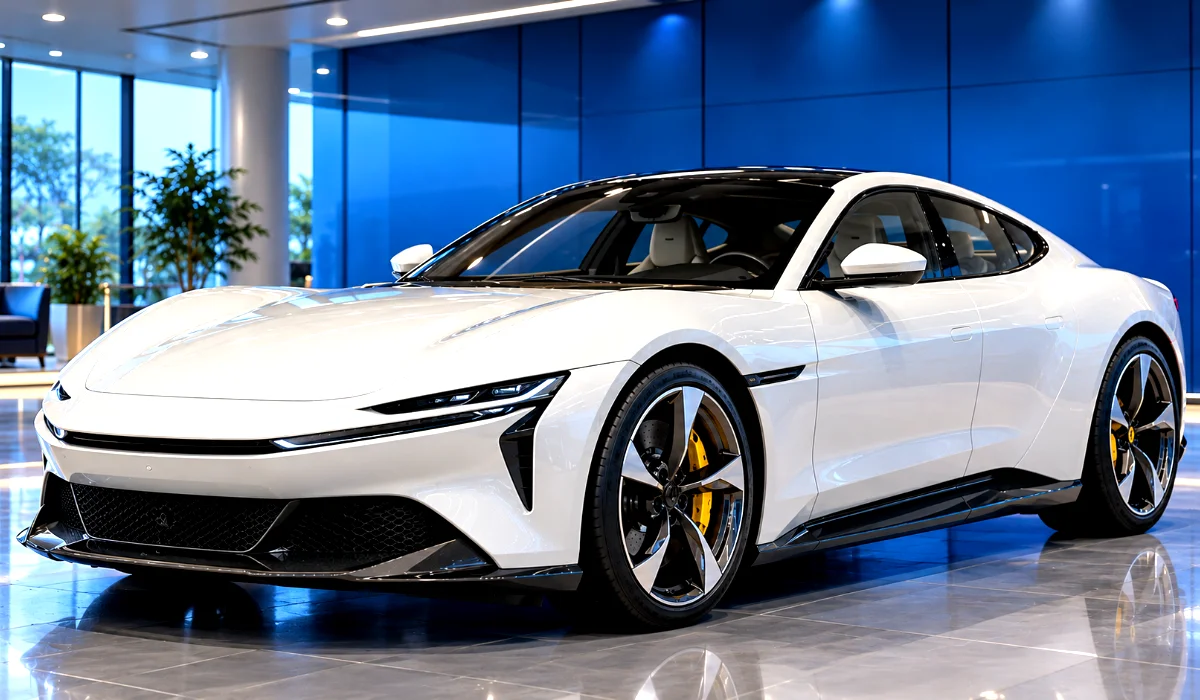
The Ferrari Luce India debut is an exhibition appearance, not a retail launch. Ferrari’s first fully electric production car is on display at Universo Ferrari in New Delhi from October 17 to November 1, alongside cars that tell a broader story about the brand’s road-car, racing and design history. For Indian visitors, it is a rare chance to see Ferrari’s electric direction before the car reaches local showrooms.
The Luce matters beyond the exhibition. Ferrari has built its reputation around combustion engines, racing and a particular kind of driver involvement. Its first full EV asks whether the brand can carry those ideas into a five-seat electric grand tourer. Ferrari quotes more than 1,000cv, a 0–100km/h time of 2.5 seconds, a top speed of 310km/h and range of more than 530km. Those are manufacturer claims, and the final homologated range and market specifications may differ.
Ferrari Luce India debut: exhibition, not an India launch
Universo Ferrari is the first edition of the exhibition in India and the fifth globally, according to Autocar India. The event brings together the brand’s history, motorsport technology and current road cars. The Luce’s appearance is a display debut, not confirmation of an Indian booking window, price or delivery timeline. Overseas order books and pricing reports should not be used to imply that Ferrari has announced the model’s India commercial plan.
That distinction is useful because a display car can create an impression of availability. Visitors may see the finished exterior, cabin and technical ideas, but a local product launch requires more: homologation, price, warranty, service arrangements, charging support and a delivery schedule. Ferrari has not publicly confirmed those India details in the reports reviewed for this article.
The Luce is also not a compact sports car. At 5,026mm long, it is a large four-door, five-seat grand tourer. It is designed to combine electric performance with the space and comfort expected of a premium long-distance car. That puts it in a different conversation from two-seat supercars and means the interior, ride quality and passenger experience have as much to prove as acceleration.
Four motors and a 122kWh battery: the mechanical headline
The Luce uses four electric motors, one at each wheel, with a 122kWh battery and an 800-volt electrical architecture. Autocar India reports combined output of 1,050hp and 990Nm, a top speed of 310km/h and a claimed range of up to 530km. The same report says the car can accelerate from 0 to 100km/h in 2.5 seconds. Ferrari’s official specification material gives power in metric horsepower (cv), so headline conversions can vary slightly depending on the unit used.
Four independent motors let engineers manage torque at each wheel, potentially supporting precise traction and handling control. They also add complexity and weight. Sustained performance depends on battery temperature, inverter limits, tyres and software; a launch figure cannot show how the car behaves over a long drive or repeated track laps.
Ferrari lists DC charging at up to 350kW. That peak does not reveal the charging curve, preconditioning behaviour or time over a practical battery window. Those details will matter more to owners than a headline maximum.
The cabin: physical controls in a digital car
The Luce blends screens with physical controls. Its cabin includes a 10-inch central touchscreen and a 12.5-inch OLED driver display, with the steering wheel and instrument binnacle designed as a connected interface. Ferrari worked with LoveFrom, founded by Jony Ive and Marc Newson. The test is whether the controls are intuitive at speed, not just distinctive in photos.
Ferrari has retained tactile switches and controls rather than pushing every function into a touchscreen. That may appeal to drivers who want to adjust settings without navigating a menu. However, the location, feedback and logic of those controls matter. A button can be physical yet still be difficult to use if it is small, hidden or overloaded with functions. Visitors to the exhibition can examine the design, but only a drive can reveal whether the interface works naturally on the road.
The five-seat layout is also a significant change for Ferrari. It asks the brand to serve more than the driver and front passenger. Rear-seat room, access, luggage space and ride comfort will influence whether buyers view the Luce as a genuine grand tourer or primarily as a technology statement. Ferrari’s design may be dramatic, but the car still needs to make long journeys comfortable for the people inside it.
What the Luce has to prove as a Ferrari
Ferrari has said the Luce should retain the brand’s emotional connection to driving. In an EV, that challenge includes acceleration and handling, but also sound, pedal response and steering feel. Ferrari has described a sound strategy using mechanical vibrations from the electric powertrain to provide an aural cue rather than adding a generic engine recording. The aim is to create feedback tied to the car’s actual operation.
That approach is interesting because EVs are naturally quiet, but sound alone cannot replace an engine’s changing revs or the interaction of a gearbox. The Luce will need to create a consistent character through steering, chassis control and throttle response. Ferrari’s four-motor layout and active systems offer tools to do that, but the result will be judged by how coherent the car feels, not by the number of motors it uses.
The premium electric market is crowded with fast, expensive EVs, so Ferrari cannot rely on acceleration alone. The Luce must feel special in craftsmanship, driving response and long-distance comfort. Its five-seat layout could attract buyers who would not choose a two-seat supercar, but it still has to feel like a Ferrari from behind the wheel.
Core Elements of Detailed Mechanical Specifications
| Specification | Ferrari Luce information published to date |
|---|---|
| Vehicle type | All-electric, five-seat grand tourer |
| Motors | Four electric motors, one per wheel |
| Maximum output | 772kW / approximately 1,050cv, manufacturer-published figure |
| Maximum torque | 990Nm at motors, as reported by Autocar India |
| Battery | 122kWh gross capacity |
| Electrical architecture | 800V |
| Maximum DC charging power | Up to 350kW, published specification |
| Claimed 0–100km/h | 2.5 seconds |
| Claimed top speed | 310km/h |
| Claimed range | More than 530km; final homologation may vary |
| Length | 5,026mm |
| Kerb weight | Approximately 2,260kg reported in published specifications |
| India price / deliveries | Not announced in the exhibition coverage reviewed |
Ferrari’s displayed or announced performance figures are manufacturer claims and should be read with the test cycle and final homologation in mind. India-specific pricing, range certification and delivery timing have not been confirmed.
CarBike Insight Analysis
The Luce’s India debut is significant because it lets local enthusiasts see Ferrari’s first electric production car as a real object, not just a set of launch images. The car’s five-seat layout, four-motor drivetrain and tactile cabin all show Ferrari attempting to broaden the definition of a grand tourer without abandoning performance.
But an exhibition appearance should not be mistaken for a market launch. No India price or delivery timeline has been announced. Nor can the car’s Ferrari character be judged from specifications alone. The final measure will be how naturally the power, steering, sound and ride work together on a real road, and whether the rear seats and charging performance make it useful for long trips.
For Ferrari, the Luce is a test of identity as much as technology. A 1,000-plus-horsepower EV is easy to headline; a convincing electric Ferrari needs to do more than accelerate quickly. It must feel carefully made, emotionally engaging and usable enough to justify its grand-touring role. The Delhi exhibition makes that debate visible to Indian fans. The driving experience will decide it.
-
Ferrari Luce Makes Its India Debut: What the First Electric Ferrari Says About the Brand’s Next Era
The Ferrari Luce India debut is an exhibition appearance, not a retail launch. Ferrari’s first fully electric production car is on display at Universo Ferrari in New Delhi from October 17 to November 1, alongside cars that tell a broader story about the brand’s road-car, racing and design history. For Indian visitors, it is a…