VinFast e-scooter patent in India has drawn attention because the design resembles the Vietnamese company’s Viper electric scooter. The filing is a useful clue that VinFast is protecting designs for the Indian market, but it is not a launch announcement. It does not confirm a model name, final specification, price, dealership date or whether the patented scooter will be produced locally.
The design-patent story surfaced in June 2026, with further reporting in July describing additional VinFast two-wheeler filings. That timing matters: this is not a brand-new filing from today. It remains relevant because VinFast has previously discussed plans to enter India’s electric two-wheeler segment, and design protection can be one part of preparing a product for a new market.
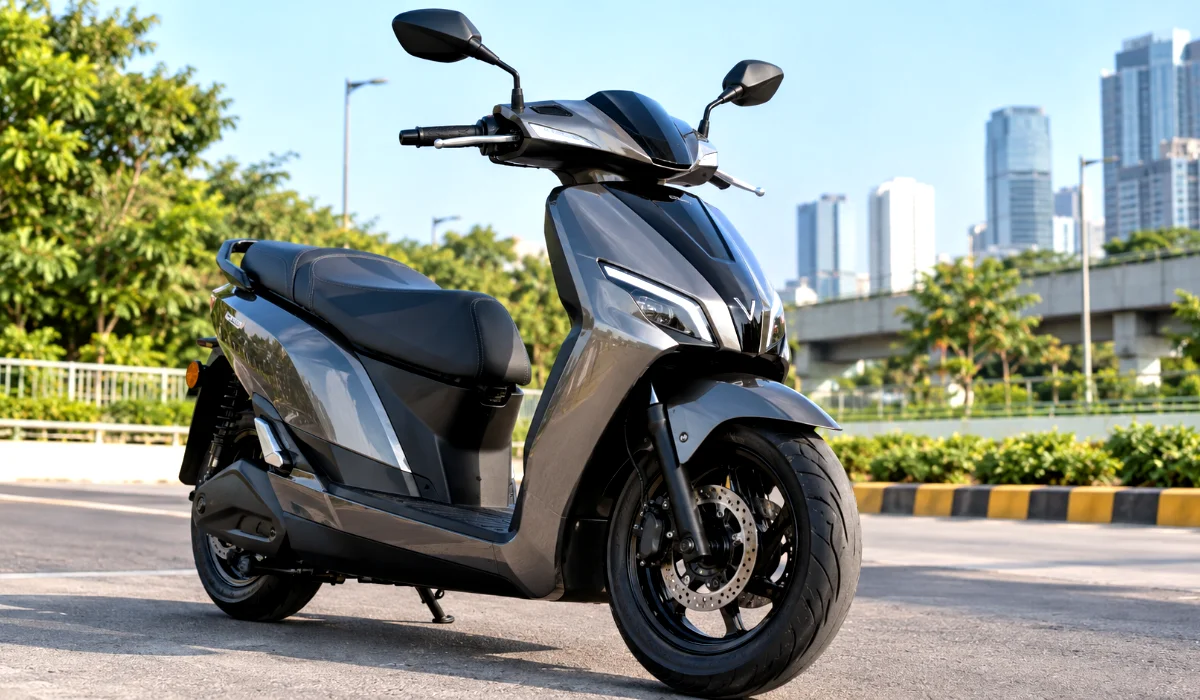
The scooter shown in the earlier filing has an angular overall shape similar to the Viper sold in Vietnam. The design imagery also shows differences, including a twin-pod headlamp arrangement and rounder body panels compared with the production Viper’s single-piece angular light. A later filing reported by Autocar India appears closer to the existing Viper, with a similar silhouette, five-spoke alloy wheels and a hub-mounted motor.
That resemblance makes the Viper a useful reference point, but it should not be treated as proof that India will receive the same scooter. Companies can patent designs to protect styling, explore multiple versions or prevent competitors from copying a visual idea. The final production model may differ, and a filing may never turn into a showroom product.
What the patent image appears to show
The scooter has a sporty, compact silhouette, chunky tyres and a hub motor integrated into the rear wheel. The visible form suggests an urban scooter rather than a large touring machine. Details such as the headlamp, body panels and wheel design point toward a product intended to stand out in a crowded electric two-wheeler market.
However, design patents usually focus on visual appearance. They do not necessarily disclose the battery chemistry, motor rating, range, charging time, top speed, kerb weight or software features. Any technical figures attached to the existing Viper in Vietnam are reference information only; they are not confirmed specifications for the Indian patent design.
The current Viper product information in Vietnam describes a removable-battery format and a 3kW motor for certain versions. A VinFast page lists a 1.5kWh LFP battery with an optional second battery and a claimed range of about 156km under a specified test condition at 30km/h. That range is a controlled test figure, not a likely everyday promise in Indian traffic. Conditions, speed, payload, temperature and riding mode affect actual distance.
Autocar India’s reporting on a later patent also mentions a 4.8kWh battery and 3kW hub motor for the current Viper model. Different market versions and reporting dates can account for the apparent variation in battery details. The takeaway is not that one set of figures will apply in India; it is that the overseas Viper provides a family resemblance, while the local product remains unconfirmed.
Patent does not mean launch
An Indian design filing means the company is seeking protection for a visual design within the legal system. It can indicate product interest or preparation, but it is not evidence that a vehicle has completed homologation, passed local testing, entered production or received a retail price.
The distinction matters because product-patent headlines can easily sound more definite than the underlying document. A patent may cover a styling idea without revealing the actual technical platform. It may coexist with several versions, or the manufacturer may decide that the economics no longer support the model.
VinFast has previously indicated plans to bring electric scooters to India during 2026 and had identified models from its Vietnamese range as candidates, according to Autocar India. The company has not, in the reports cited here, confirmed that the Viper-like design is the first Indian scooter, nor published a final India launch schedule. Until a formal announcement appears, model selection and timing remain open.
Core Elements of Detailed Mechanical Specifications
| Item | What is known |
|---|---|
| Patent subject | Design of a VinFast electric scooter with Viper-like styling |
| Filing status | Design patent reported in India in 2026 |
| India launch | Not confirmed |
| Indian specifications | Not announced |
| Overseas reference model | VinFast Viper sold in Vietnam |
| Overseas motor information | 3kW hub motor listed for a Viper version |
| Overseas battery information | Market/version dependent; VinFast lists 1.5kWh LFP with optional second battery on one version |
| Claimed range reference | About 156km with two batteries under VinFast’s 30km/h test condition |
| India price and dealer network | Not announced |
These overseas figures are not Indian homologated specifications. The patent image itself does not prove which battery or motor the eventual Indian scooter would use.
The Indian market challenge is bigger than styling
India’s electric scooter market already includes established brands with dealer networks, charging or battery-support systems, financing options and service experience. VinFast would need to explain where customers can buy the scooter, how warranty claims work, how replacement parts are stocked and what happens if a battery needs repair.
The product’s battery strategy could be especially important. A removable battery can suit riders who lack a dedicated parking charger, but only if the pack is manageable in weight and the home charging process is straightforward. A fixed pack may allow different packaging and protection, but it places more importance on access to a plug and service support. The patent images do not answer which approach the India-spec scooter will use.
Range claims also require careful comparison. A stated test-cycle distance at a fixed low speed cannot be compared directly with a user’s daily commute. Indian buyers should look for test protocol, battery capacity, usable energy, charging time and performance with a passenger. The ability to maintain speed on flyovers and in hot weather can matter more than a theoretical maximum range.
Local assembly, pricing and after-sales coverage may shape VinFast’s prospects as much as the scooter’s styling. If it enters India with a competitive price but a thin service network, customers may hesitate. If it builds visible support and offers transparent battery warranties, the product could be taken more seriously even in a crowded segment.
What prospective buyers should watch next
The clearest confirmation would be a VinFast India product announcement that names the scooter, shows the production version and lists its launch markets. Buyers should then look for the final battery and motor specifications, certified range, charging time, warranty, safety equipment and price.
The company should also clarify whether the scooter will be sold through dedicated stores, existing automotive outlets or an online channel, and where service centres will operate. For electric two-wheelers, dependable parts supply and battery support are part of the product, not optional extras.
If a second VinFast electric motorcycle design is also protected in India, that may indicate broader interest in the category. It still does not guarantee a launch. Multiple design filings can reflect exploration of future products rather than a confirmed retail plan.
CarBikeInsight Analysis
The Viper-like design patent is a credible sign that VinFast is evaluating how its electric two-wheeler styling could fit the Indian market. It is a useful clue, especially alongside the company’s earlier stated interest in entering the segment. But it is only a clue. The patent does not prove the scooter will be launched, assembled in India or sold with the same battery and motor as the Vietnamese Viper.
The design itself appears to target urban buyers who want a more assertive scooter shape than a conventional commuter. The real test will come from range under Indian conditions, battery convenience, price and the quality of local support. A 3kW motor and removable battery can make sense for city mobility, but customers will need to know whether the final model matches their daily distances and charging access.
VinFast has a chance to enter with an established international EV identity, but India rewards execution. Riders will compare the scooter against familiar products and judge not only acceleration or claimed range, but also service turnaround, spare parts, resale confidence and battery replacement cost.
For now, the accurate headline is that a Viper-like VinFast scooter design has been patented in India. The next milestone is a confirmed production model with India-specific specifications. Until that happens, any launch date, rupee price or range figure for the Indian scooter should be labelled as unconfirmed.
-
VinFast e-scooter patent in India: what the Viper-like design signals
VinFast e-scooter patent in India has drawn attention because the design resembles the Vietnamese company’s Viper electric scooter. The filing is a useful clue that VinFast is protecting designs for the Indian market, but it is not a launch announcement. It does not confirm a model name, final specification, price, dealership date or whether the…