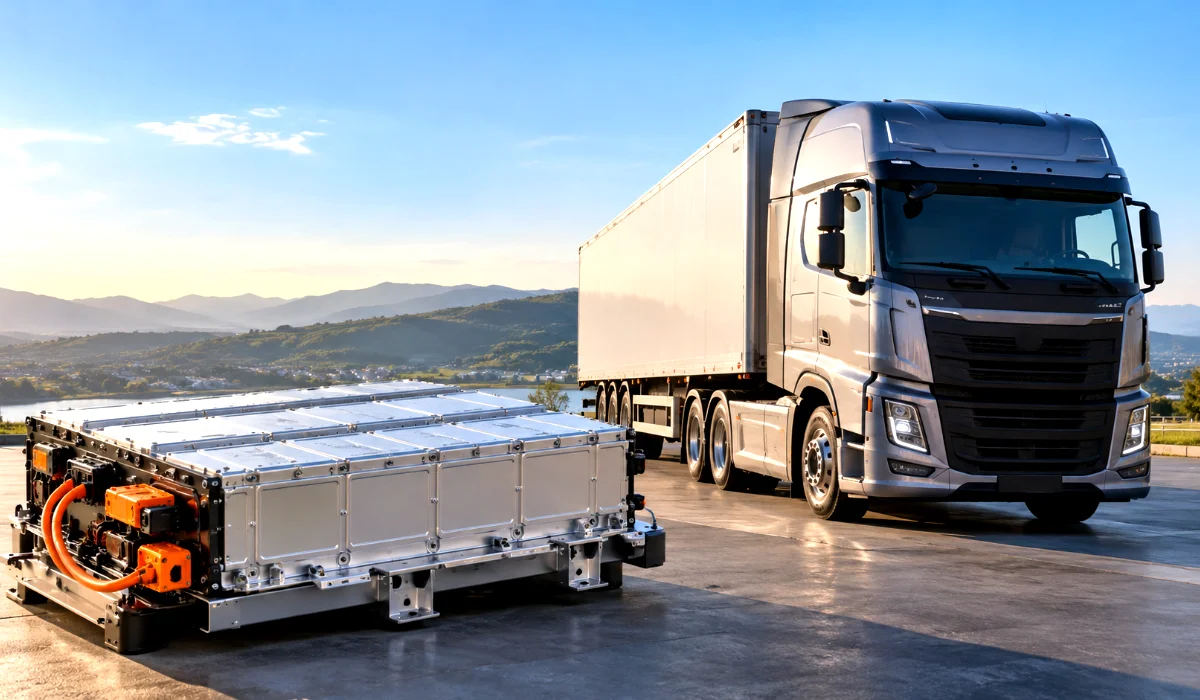
Gotion truck battery technology is in focus after the company introduced a cell-to-body system integrated behind the cab of heavy-duty vehicles. The design shifts attention from chemistry, capacity and charging speed to a less discussed question: where the pack sits and how many structural layers surround it. Shanghai Metals Market reports that the system could reduce vehicle weight by about 400kg compared with a conventional arrangement, a figure that should be treated as a reported claim until independently validated.
That figure is striking because every kilogram matters in commercial transport. A lighter truck can potentially carry more payload within the same gross vehicle weight limit, or use less energy to move itself and its load. But the claimed saving is not yet an independently validated fleet result. Gotion’s reported figures should be treated as manufacturer data relayed by a trade publication until customers, operators or third-party testing confirm them.
The new pack is reported to offer 400kWh to 700kWh capacity options for different heavy-duty applications. Gotion also claims the battery pack reduces height by 40 percent to 943mm, reaches 250Wh/L volumetric energy density and exceeds 160Wh/kg at pack level. The system is said to have completed 6,000km of vehicle testing. Those are useful early specifications, but they do not tell us how the pack performs through years of loading, vibration, temperature extremes and repeated fast charging.
Gotion truck battery design: what cell-to-body means in a heavy truck
Traditional battery packs are built as assemblies, often with cells grouped into modules and modules mounted inside a pack enclosure. That enclosure then has to be attached to a vehicle frame or integrated into its structure. A cell-to-body approach aims to reduce the number of intermediate layers by making the battery part of the vehicle’s structural layout. Gotion’s new product is mounted behind the cab, an area often used for battery packaging on heavy-duty electric trucks.
Removing redundant frames and modules can make packaging more compact. A lower pack height may also affect the truck’s centre of gravity and fit around the cab and chassis. But integration makes engineering trade-offs more demanding. A structure that saves weight must still protect cells in a collision, withstand torsional loads, resist water and dust ingress, manage heat and allow technicians to inspect or replace damaged components.
The word “integrated” should not be confused with “easy to repair.” A highly integrated pack can improve packaging and stiffness, but the service strategy matters. Fleet managers need clear answers about whether the pack can be repaired by module, whether a damaged section requires a full replacement and how long a truck will be out of service. Those questions influence total cost of ownership as much as the initial purchase price.
Why a 400kg saving could matter
Heavy trucks operate within strict weight limits. If a battery installation is lighter without reducing usable energy, the operator may gain more payload capacity or reduce energy spent moving the vehicle. For a logistics company making repeated trips, even a modest payload improvement can change route economics. The value is especially relevant for regional freight, where trucks may need enough energy for a full working shift but still return to a depot or charging hub.
The benefit depends on the reference vehicle and duty cycle. A 400kg saving is not automatically equivalent to a 400kg increase in legal payload: axle limits, body equipment, national regulations and the truck’s gross vehicle weight rating all matter. Nor does a lower battery mass guarantee more range. Range is affected by route speed, gradients, ambient temperature, load, tyres, aerodynamics and auxiliary systems such as cabin climate control.
Gotion’s reported 400–700kWh range reflects different use cases rather than one universal pack. A 400kWh configuration might suit shorter distribution routes, while larger capacities could target longer regional work. The trade-off is straightforward: more capacity adds cell mass and cost, while larger packs can provide greater route flexibility. Operators will need real duty-cycle data to choose the right balance.
Thermal management and durability questions
The SMM report says the pack uses external cooling pipes, with optional PTC heating. External cooling lines can simplify some aspects of thermal control and potentially reduce internal pack complexity, but the layout must be protected from road debris and service damage. PTC heating may help bring the battery toward a usable temperature in cold conditions. The exact efficiency, operating strategy and impact on winter range have not been published in the material checked for this draft.
The reported 6,000km vehicle test is a starting point, not proof of commercial durability. A heavy truck accumulates mileage quickly and experiences loads different from a passenger car. Long-haul and construction-related duty cycles can involve vibration, uneven surfaces, high payloads and frequent high-power charging. A robust validation programme needs thermal cycling, crash protection, water ingress tests, vibration endurance and battery ageing data.
The battery industry also needs transparent measurement standards. Pack energy density can be stated by volume or mass, and different boundaries can produce different numbers. Cell-level density is not the same as pack-level density. Gotion’s reported figures are specifically described as 250Wh/L volumetric and over 160Wh/kg pack-level, which makes them more informative than a cell-only claim, but direct comparison still requires common test methods and equivalent pack definitions.
Core Elements of Detailed Mechanical Specifications
| Battery / vehicle element | Reported Gotion figure | What fleets should ask next |
|---|---|---|
| Packaging concept | Cell-to-body, behind cab | How is the pack protected and attached to the chassis? |
| Capacity range | 400–700kWh | Which capacity suits each route, payload and charging window? |
| Pack height | 943mm, reported 40% reduction | What is the full pack envelope and effect on cab/chassis layout? |
| Volumetric density | 250Wh/L | What measurement boundary and test conditions were used? |
| Pack-level gravimetric density | More than 160Wh/kg | How does this compare with a like-for-like commercial pack? |
| Vehicle weight saving | About 400kg claimed | Against which vehicle configuration and equipment level? |
| Thermal provisions | External cooling pipes; optional PTC heating | What are cold-weather performance and service requirements? |
| Testing | 6,000km vehicle test reported | What longer-duration durability data will customers receive? |
The business case for electric heavy trucks
Battery packaging is only one part of a commercial EV’s economics. Fleet buyers also calculate electricity prices, charging access, vehicle financing, residual value, maintenance downtime and route utilisation. A more compact pack may make vehicle design easier, but if the truck cannot recharge during scheduled breaks or return to a depot with sufficient reserve, the specification will not rescue the business case.
Charging infrastructure is particularly important for the 700kWh end of the range. Operators need to know how quickly the truck can recharge, what connector and charging standard it uses, and whether charging power can be sustained without excessive battery heating. Gotion has not supplied those details in the trade report. It would be premature to infer charging speed from energy density alone.
The behind-cab position can also preserve chassis space, but the truck’s final layout depends on body type, axle configuration and customer equipment. A battery pack that works for a tractor unit may require different integration for a rigid delivery truck. Fleet operators will want product variants and homologation data before placing orders.
CarBike Insight Analysis
Gotion’s new truck battery is interesting because it targets a practical bottleneck: the mass and packaging penalty of large battery systems. A claimed 400kg reduction and a lower pack profile could improve payload flexibility, while a 400–700kWh range gives the company room to address more than one type of route. The cell-to-body strategy also reflects a wider shift toward treating the battery as part of vehicle architecture rather than a box bolted on afterward.
The announcement is still an early data point. The reported test distance is limited, the figures have not been independently verified, and core buyer information such as charging performance, warranty, repairability, price and long-term degradation is missing. For fleet operators, the next evidence should come from production trucks working real routes over a meaningful period. If the weight saving holds without compromising safety and serviceability, the design could matter. Until then, the headline number is a promising claim, not a procurement decision.
-
Gotion’s New Truck Battery Could Save 400kg. The Hard Part Is Proving It on the Road
Gotion truck battery technology is in focus after the company introduced a cell-to-body system integrated behind the cab of heavy-duty vehicles. The design shifts attention from chemistry, capacity and charging speed to a less discussed question: where the pack sits and how many structural layers surround it. Shanghai Metals Market reports that the system could…