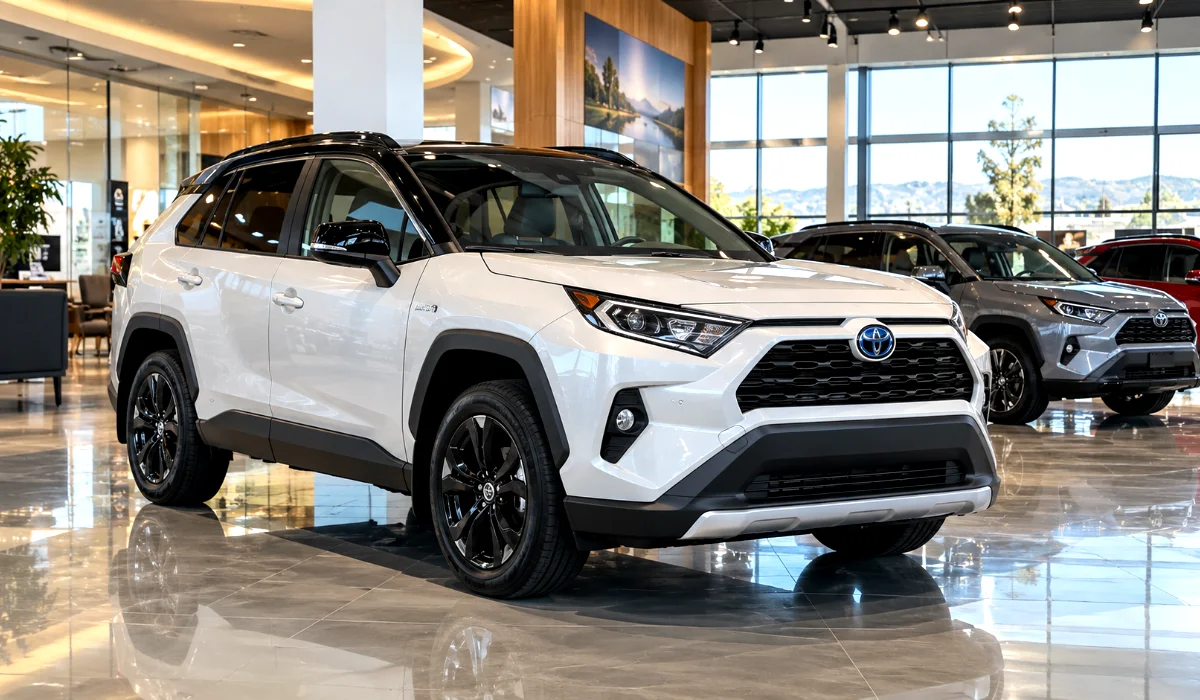
Toyota RAV4 Shortage: The Toyota RAV4 is usually one of the easiest high-demand SUVs to find in the United States. That has changed during the transition to the redesigned 2026 model. A report published on 21 October says some buyers are facing long waits, while dealer stock has fallen to only a few days of supply.
The headline figures are striking: North American production was down 30 percent through September, according to AutoForecast Solutions data cited in the report, while US RAV4 sales were down 29 percent year over year. Toyota dealers reportedly had about four days of RAV4 inventory, compared with an industry average of 51 days in September, according to Motor Intelligence.
Those numbers describe a US and North American supply issue. They should not be applied to Toyota availability in India or other markets, where the RAV4 is sold under different conditions or may not be offered at all. The story is still globally relevant because it shows how a popular model can become scarce when a factory transition, production ramp-up and strong demand collide.
Why is the Toyota RAV4 in short supply?
The central factor is the change from the previous-generation RAV4 to the new 2026 model. Toyota continued building the 2025 version into the fourth quarter of the previous year, delaying factory retooling needed for the new model. A model changeover can interrupt production even when demand remains strong: equipment must be modified, suppliers need to deliver new or revised components, and production teams have to stabilize build quality before output can be raised.
The transition matters especially for the RAV4 because it is a high-volume product. Any pause or slower ramp has a visible effect on dealer lots. Toyota has said production at US and Canadian factories has averaged more than 30,000 RAV4 units a month since April, operating near capacity, according to the reporting. That is a substantial output, but it has not yet restored normal availability in every part of the market.
The launch also coincides with the new RAV4 range becoming hybrid-focused in North America. Toyota’s strategy is to offer hybrid and plug-in hybrid versions, increasing the importance of battery and electrified-powertrain supply. The exact contribution of individual components to current inventory constraints has not been fully established in the public information reviewed, so it would be premature to blame a specific battery or supplier bottleneck.
Toyota RAV4 Shortage What do four days of inventory mean for buyers?
“Days of supply” estimates how long current dealer inventory would last at the recent sales pace if no additional vehicles arrived. Four days does not mean every dealer has exactly four days of cars, nor does it mean every buyer will wait the same length of time. Inventory varies by region, trim, colour and drivetrain. A buyer willing to accept a different configuration may find a vehicle faster than someone seeking a specific plug-in hybrid or option package.
When inventory is tight, customers may need to reserve an incoming vehicle, widen their search area or compromise on colour and equipment. Dealers may have less incentive to discount a model that sells as soon as it arrives. That can change the buying experience even when the vehicle itself has not changed: shoppers have less time to compare, and the first available unit may not be their preferred specification.
It is worth distinguishing a temporary production transition from a permanent inability to supply demand. The current figures show a short-term imbalance; they do not prove Toyota will remain unable to meet demand. The company has described a steady flow to dealers, while manufacturing output is already at high levels. Future availability depends on how quickly production can continue to stabilize and whether output reaches the market where demand is strongest.
2026 Toyota RAV4 powertrain and mechanical overview
The 2026 RAV4 is built on Toyota’s TNGA-K unibody architecture. In North America, the redesigned range is centered on hybrid and plug-in hybrid powertrains. Toyota has announced that hybrid models are assembled in Kentucky and Ontario, Canada, while plug-in hybrid models are built in Japan. These production locations matter because a constrained plant or a delayed ramp at one location can affect particular versions more than others.
The hybrid system combines a petrol engine with electric motors and does not require external charging. The plug-in hybrid adds a larger rechargeable battery and can travel on electricity for some trips before operating as a hybrid. Exact output, range, charge time and equipment depend on version and market. Buyers should use the local Toyota specification sheet for confirmed figures rather than importing numbers from another region.
Core Elements of Detailed Mechanical Specifications
| Specification | 2026 Toyota RAV4 information relevant to this story |
|---|---|
| Architecture | Toyota TNGA-K unibody platform |
| Powertrain types | Hybrid and plug-in hybrid in the announced North American range |
| Production | HEV at Toyota facilities in Kentucky and Ontario; PHEV in Japan |
| Drive system | Varies by grade and powertrain; consult the local market specification |
| Capacity/output/range | Varies by trim and market; no single figure applies to every version |
| Current issue | Availability and production ramp, not a mechanical defect |
| Recall status | This supply story is separate from safety recall notices; owners should check VIN-specific notices |
Should buyers wait or choose another SUV?
The right decision depends on urgency and flexibility. Buyers who need a vehicle immediately may want to compare other compact SUVs with confirmed local inventory. Those committed to the RAV4 can ask dealers for allocation status, an estimated arrival window and whether the deposit is refundable. It is useful to confirm that the quoted vehicle has a production or shipping allocation rather than relying on a broad estimate.
Customers should compare the total price, financing terms and optional equipment, not just the vehicle’s advertised starting price. A tight market can make add-ons or dealer-installed accessories more common. Buyers should request an itemized quote and ensure that any promised delivery date is recorded in writing.
Waiting can make sense if the RAV4’s hybrid efficiency, resale reputation or specific plug-in capability is central to the purchase. But a buyer should not assume that scarcity guarantees future value or that a long wait will necessarily produce a better deal. Availability can improve as production catches up, but timing remains uncertain.
CarBike Insight Analysis
The RAV4 shortage is a useful reminder that a popular model’s success can create its own supply challenge, especially during a complete generation change. The reported inventory gap is not evidence of a flawed vehicle; it reflects the timing and pace of production. Toyota has invested heavily in the new model and is already producing at high monthly volumes, but dealers still need a dependable stream of the right versions.
For shoppers, the practical lesson is to treat availability as part of the purchase decision. If the RAV4 is the preferred choice, verify the exact unit, timeline and price before paying a deposit. If a vehicle is needed now, compare alternatives on real inventory and ownership costs. The supply picture could change over the coming months, so buyers should check current dealer allocations rather than assuming today’s wait applies everywhere.
-
Toyota RAV4 Shortage: Why America’s Best-Selling SUV Is Hard to Find
Toyota RAV4 Shortage: The Toyota RAV4 is usually one of the easiest high-demand SUVs to find in the United States. That has changed during the transition to the redesigned 2026 model. A report published on 21 October says some buyers are facing long waits, while dealer stock has fallen to only a few days of…