The automotive software industry 2035 outlook is coming into sharper focus: carmakers expect software and digital services to become central to how they compete. For decades, buyers compared engines, ride quality, design, reliability and price. Those things still matter, but a new KPMG survey suggests the next contest will also be fought through connected features and the ability to update vehicles after they leave the factory.
Published on 21 October, KPMG’s 26th Global Automotive Executive Survey gathered responses from 775 industry leaders. The survey found that 51 percent expect software and digital technologies to become their company’s primary competitive differentiator by 2035. Reuters’ summary of the findings also reports that 48 percent expect six of the world’s ten largest automakers to be headquartered in China by that year.
These are executives’ expectations, not guaranteed outcomes. The survey is valuable because it captures how decision-makers see the industry changing, but it does not prove that software will replace engineering or that China will necessarily occupy six of the top ten positions. The more immediate signal is that carmakers believe digital capability has become a strategic priority.
Automotive software industry 2035: what could change?
KPMG’s survey describes a possible shift in competitive advantage rather than a settled prediction. Fifty-one percent of the executives surveyed expect software and digital technologies to become their company’s primary differentiator by 2035. If that view proves accurate, automakers will compete not only on the vehicle delivered at purchase, but also on how well its digital systems work and improve over time.
That forecast does not mean software will replace engineering. The stronger interpretation is that software will increasingly connect the car’s hardware, services and ownership experience. The brands that make those pieces work together reliably may gain an advantage; the ones that simply add screens or subscriptions may not.
What does software-defined mean in a car?
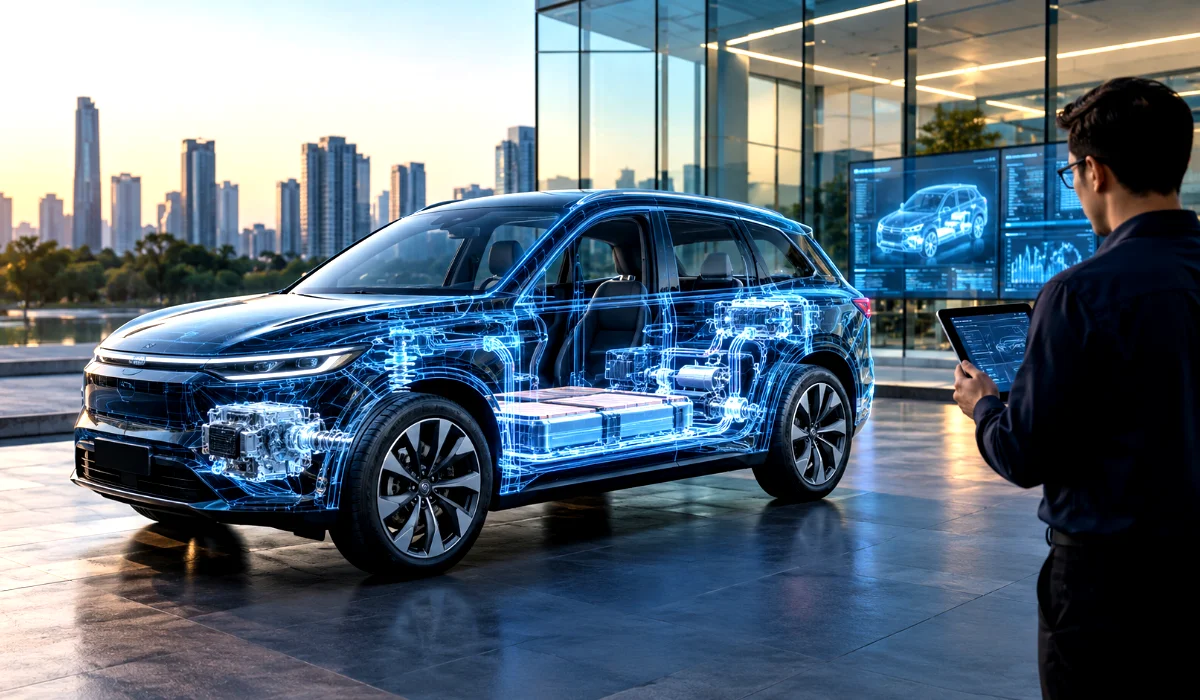
A software-defined vehicle uses computing systems and software to control or improve functions that were once fixed largely by hardware. Examples include infotainment, navigation, energy management, driver assistance, battery monitoring, cabin features and connected services. Some functions can be updated remotely, allowing manufacturers to change or improve features after sale.
That shift has potential benefits. A manufacturer may fix certain software issues without asking every customer to visit a workshop. Drivers could receive interface improvements or new functionality over time. Connected services can also help fleet operators monitor vehicles and plan maintenance.
There are trade-offs. A car that depends heavily on software needs strong cybersecurity, reliable connectivity, clear privacy policies and a long-term update plan. Owners need to know which features are included, which require subscriptions and how long support will continue. Remote updates must be carefully tested because errors can affect safety-critical systems or disable functions that drivers rely on.
Software does not make mechanical engineering less important. Brakes, tyres, steering, suspension, crash structure and powertrain still determine how a vehicle behaves in the physical world. Software can coordinate these systems, but it cannot compensate for poor hardware design or inadequate validation.
Why the competitive landscape may change by 2035
The automotive software industry 2035 outlook also sits alongside a possible change in the global competitive map. The survey’s China finding points to a second major shift. Chinese automakers have expanded rapidly in electric vehicles, batteries and digital features, and many have developed shorter product cycles in their domestic market. If they gain more share internationally, established manufacturers will face stronger competition on price, development speed and user experience.
The survey says 48 percent of respondents expect six of the ten largest global automakers to be Chinese by 2035. That is a forecast about executive expectations, not a ranked projection with certainty. The result nevertheless shows how seriously industry leaders view China’s manufacturing scale and technology ecosystem.
The challenge for traditional companies is organizational as much as technical. Automakers have to coordinate engineering, software, suppliers, manufacturing, data security and after-sales service. A company may build a capable vehicle yet struggle to deliver timely software updates or a consistent connected experience across regions. Conversely, a polished digital interface cannot rescue an unreliable vehicle.
KPMG’s survey also reports that 92 percent of executives need at least 12 months to deploy AI, software or digital initiatives, while more than one-third say these efforts take over two years. This underlines the distance between announcing a technology strategy and delivering it at scale. Automakers are large organizations with legacy platforms, regulatory obligations and complex supplier networks. Integrating new software safely across millions of vehicles is a demanding process.
What drivers may notice first
Consumers are likely to encounter the shift through more frequent over-the-air updates, richer navigation, improved phone integration and added driver-assistance features. Some manufacturers may offer performance or comfort functions through digital subscriptions. Fleet buyers could see more detailed vehicle-health information and remote management tools.
The best outcomes will be quiet and useful: a navigation system that remains current, a charging planner that works reliably, or a safety system that behaves consistently. The worst outcomes would be features hidden behind recurring fees, interfaces that distract, or software that changes the vehicle in ways owners do not understand.
Buyers should ask practical questions when comparing connected vehicles: How long will the manufacturer provide updates? Can essential features work without a subscription? What data is collected and shared? Can the owner control connected services? Are critical functions available when mobile coverage is poor? What happens if the manufacturer discontinues an app or online service?
Core Elements of Detailed Mechanical Specifications
This is an industry-trend story, not a vehicle launch. No new vehicle’s mechanical specification was announced by the KPMG survey. The relevant technical elements are the systems that make digital capability work safely alongside conventional hardware.
| Technical area | Why it matters |
|---|---|
| Electronic control units | Coordinate powertrain, braking, chassis, body and cabin functions |
| Vehicle software architecture | Determines how systems communicate and how updates are validated |
| Connectivity | Enables remote services and over-the-air updates; availability depends on network coverage |
| Cybersecurity | Protects vehicle systems, user accounts and connected data from unauthorized access |
| Sensors and driver assistance | Supply data used by safety and convenience functions; capability varies by model |
| Mechanical systems | Brakes, steering, tyres, suspension and structure remain essential to safe performance |
| Update support | Manufacturers should state update duration, feature availability and service terms |
The industry’s hard problem is execution
The business case for software is not simply that automakers can sell more digital features. They must build systems that work across vehicle models, suppliers and regulatory environments. They also need to maintain software over the life of a vehicle, which can be much longer than the technology cycle of a phone or computer.
AI may help companies analyze vehicle data, improve development processes or personalize services, but it adds governance questions. Companies need to verify how data is used, prevent insecure access and make sure automated decisions are tested. In a vehicle, a software mistake can affect movement, visibility or driver workload. Reliability is not optional.
The transition also affects the workforce. Mechanical engineers, software developers, cybersecurity specialists and data teams need to work together from the start of a vehicle programme. If software is added late, the result can be fragmented systems and expensive rework. If digital features are planned alongside the vehicle’s architecture, manufacturers have a better chance of delivering coherent updates and support.
CarBike Insight Analysis
The KPMG survey captures a real change in how automakers define product value. A car is increasingly a physical machine connected to a software platform, but the customer still judges it as one whole product. A clever interface cannot excuse poor ride quality, and a strong engine cannot offset a confusing or insecure digital experience.
The 2035 forecasts should be read as a direction of travel, not a guaranteed industry map. The more useful takeaway for readers is to watch execution: which brands provide dependable updates, explain data use clearly and support vehicles for a meaningful period? Manufacturers that do those basics well can turn software into a genuine ownership benefit. Those that treat it as a marketing label may find that customers care more about reliability and transparency than another screen or subscription.
-
KPMG Survey: Why Software Could Become the Auto Industry’s Biggest Battleground
The automotive software industry 2035 outlook is coming into sharper focus: carmakers expect software and digital services to become central to how they compete. For decades, buyers compared engines, ride quality, design, reliability and price. Those things still matter, but a new KPMG survey suggests the next contest will also be fought through connected features…