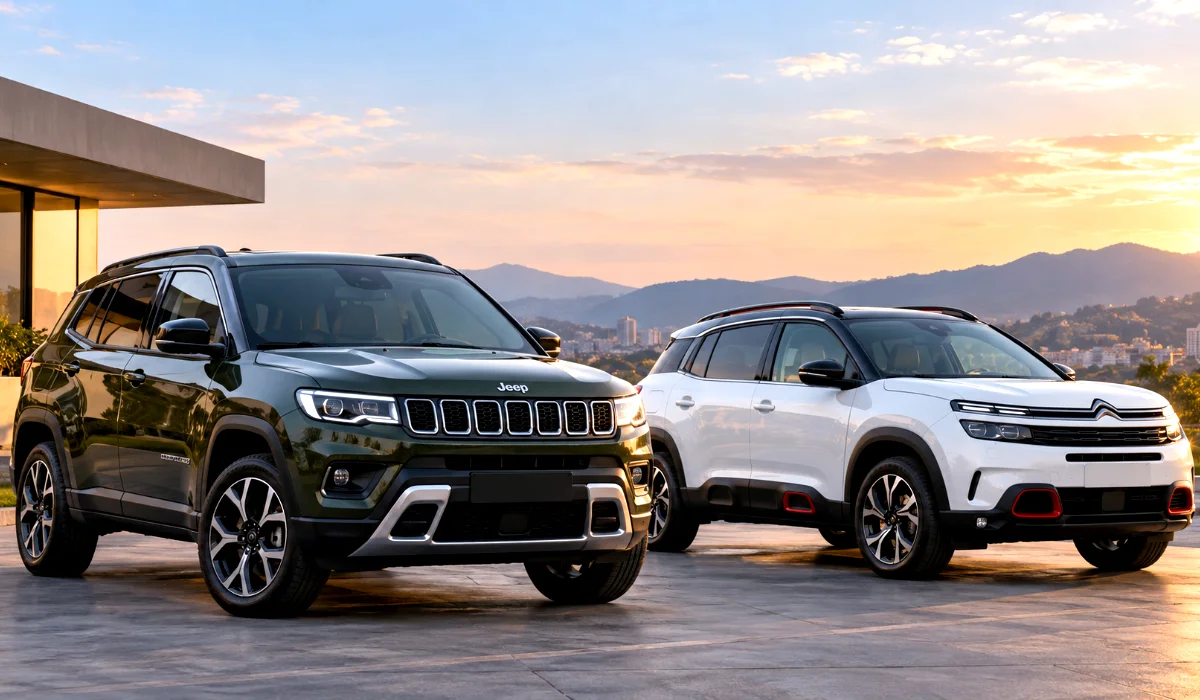
Stellantis India 12 new models are at the centre of the company’s expansion plan for Jeep and Citroën. Stellantis says it intends to invest approximately ₹4,000 crore over three years, introduce seven all-new models and make five major product updates. It also aims to triple annual sales to around 45,000 units within the same period.
These are company targets, not achieved results. The announcement offers a direction for the business, but it does not yet provide launch dates, model names, prices or detailed specifications for every product. Buyers should treat the roadmap as a commitment to expand the portfolio, while waiting for individual vehicle announcements before making purchase plans.
The news matters because Jeep and Citroën have faced a difficult task in India: building scale in a market where buyers are value-conscious, local competition is intense and product choice changes quickly. A broader range could give both brands more chances to reach customers, but investment alone will not determine whether the plan succeeds.
Stellantis India 12 new models: what is confirmed?
The proposed ₹4,000-crore investment is intended to support product development, localisation and customer experience. The 12-product programme spans the Jeep and Citroën brands. Reporting on the company’s roadmap indicates Citroën is considering products across several segments, including an SUV, an MPV and a smaller car. Specific production models and launch timing have not been fully confirmed in the public information reviewed.
The company has also said it wants to shorten vehicle development cycles. A report published on 20 October quotes Stellantis India managing director and CEO Shailesh Hazela as saying the company is targeting roughly half the time for development and greater localisation, within the wider FaSTLAne 2030 strategy. The group’s global plan has discussed a 24-month product-development target compared with substantially longer cycles today. That is a corporate ambition, not evidence that every India-bound model will be developed in 24 months.
Stellantis has recently taken full ownership of its Thiruvallur manufacturing operation in Tamil Nadu after acquiring the remaining stake held by its former joint-venture partner. The move gives the company direct control of the facility. Separately, the company has described its Indian-developed Smart Car platform as serving India and other regions, with vehicles produced in India for selected export markets. This engineering and manufacturing base could support the new roadmap if product volumes justify it.
Why localisation and development speed matter
Localisation can help lower costs, reduce exposure to currency swings and improve the fit between a vehicle and local needs. It can also create a stronger supplier base and make it easier to adapt equipment for Indian conditions. But localisation is not a simple percentage target. The quality, reliability and availability of locally sourced parts matter just as much as their share of vehicle value.
Faster development can help a brand respond to changing demand. Indian buyers have shown strong interest in SUVs, while demand for compact cars, hybrids, CNG models and electric vehicles varies by price point and region. A quicker development process may help automakers bring products to market while a segment is growing. However, speed must not come at the expense of safety validation, durability testing, software quality or after-sales readiness.
Customer experience is another focus area in the announced investment. For Jeep and Citroën, that includes dealer reach, service access, parts availability, warranty support and resale confidence. A new product can attract attention at launch, but a dependable ownership network is what often keeps customers with a brand.
What buyers should watch for
The headline number of 12 products sounds substantial, but product count alone does not show how much the range will improve. Five major upgrades could be refreshes of existing vehicles; seven new models could target segments where the brands currently have limited representation. Buyers should look for confirmation of body style, powertrain, localisation level, price band and whether each vehicle is a new model or a derivative.
The company’s sales ambition also deserves context. Tripling annual sales to 45,000 units would require not only fresh products but a consistent cadence of launches and a broader customer base. Jeep’s positioning is associated with SUVs and off-road capability, while Citroën has sought to distinguish itself through ride comfort and value. Each brand needs to maintain a clear identity while expanding into new segments.
The investment could support petrol, hybrid, plug-in hybrid or battery-electric options. Company leadership has indicated that powertrain choices will depend on customer demand and product economics. That does not confirm a specific EV or hybrid launch. Until a model is officially named, references to a particular powertrain should be treated as possibility rather than a confirmed specification.
Core Elements of Detailed Mechanical Specifications
No single new vehicle’s mechanical specifications have been announced as part of the 12-product roadmap. The following table summarizes what is known and what remains open for each future product.
| Specification area | Status from the announced roadmap |
|---|---|
| Models | 12 product introductions: seven all-new models and five major updates |
| Brands | Jeep and Citroën |
| Vehicle segments | Company reporting points to several SUV and passenger-car segments; individual model names pending |
| Engines and motors | Not confirmed model by model |
| Transmission and drivetrain | Not confirmed model by model |
| Battery capacity and EV range | Not confirmed; no specific EV specification announced in this roadmap |
| Platform | Stellantis has described India-developed Smart Car architecture, but has not linked every roadmap product to it |
| Investment | About ₹4,000 crore over three years, according to company statements reported by Business Standard |
| Local production | Thiruvallur is wholly owned by Stellantis; future model-level production plans remain to be detailed |
Can Stellantis rebuild momentum in India?
There are reasons the plan could work. India is a large and growing market, the company has manufacturing and engineering assets in the country, and a wider product range can help improve showroom traffic. Full ownership of the Thiruvallur plant may also make decisions on investment and operations more direct.
The risks are equally concrete. Launching several vehicles in a short period requires stable suppliers, sufficient dealer capacity, reliable quality and after-sales support. Jeep and Citroën also compete against established Indian and international brands with broad portfolios and strong service networks. An attractive launch price is only part of the equation; customers will compare real-world efficiency, safety equipment, cabin space, warranty, resale and service costs.
The Stellantis India 12 new models roadmap is expected to use different powertrains according to customer demand, but model-by-model choices have not been confirmed. A C-segment SUV buyer looking for low running costs may value hybrid efficiency, while a long-distance driver may prioritize range and service access. The right powertrain depends on use, not simply on a technology label.
CarBike Insight Analysis
Stellantis India’s roadmap is important because it signals a shift from maintaining a small portfolio to pursuing scale. The planned investment and 12 product actions could give Jeep and Citroën a better chance of matching the breadth of the Indian market. Local engineering and manufacturing are useful foundations, but the results will depend on the vehicles themselves and the ownership experience around them.
The most meaningful milestones to watch are the first confirmed model details, prices, launch schedule and evidence of deeper localisation. Development speed can be an advantage only when safety, durability and quality hold up. Likewise, a bigger showroom range will matter only if dealers can support the products well after delivery.
For now, the ₹4,000-crore figure and 12-product target describe a plan, not a finished product. Buyers should wait for official specifications before assuming which engines, hybrid systems or EVs will arrive. If Stellantis executes the programme with competitive vehicles and dependable service, the expansion could materially improve its position. The proof will come one launch at a time.
Sources: [Business Standard on the ₹4,000-crore and 12-product plan]
-
Stellantis India’s ₹4,000-Crore Plan: 12 Jeep and Citroën Products, Faster Development
Stellantis India 12 new models are at the centre of the company’s expansion plan for Jeep and Citroën. Stellantis says it intends to invest approximately ₹4,000 crore over three years, introduce seven all-new models and make five major product updates. It also aims to triple annual sales to around 45,000 units within the same period.…