Hyundai Bayon SUV shoppers in India now have a new model to consider, with Hyundai Motor India revealing the India-spec vehicle ahead of its scheduled launch on 26 October 2026. Instead of focusing only on its styling or digital dashboard, buyers should look at a more practical question: will its engine, cabin technology and everyday usability justify the price Hyundai eventually announces?
The new Bayon combines a naturally aspirated petrol engine with a technology-focused cabin. Hyundai has confirmed a 1.5-litre four-cylinder MPi petrol engine producing 115 PS and 144 Nm, paired with either a six-speed manual gearbox or an Intelligent Variable Transmission (IVT). Its headline features include dual 12.3-inch displays, a generative AI voice assistant, Bluelink connectivity and over-the-air software updates.
These details make the Hyundai Bayon SUV worth watching, but specifications alone cannot establish whether it will be the right car for every household. Here are seven checks prospective buyers should make before booking or choosing a variant.
Hyundai Bayon SUV: What Is Officially Confirmed?
Hyundai has announced the India-spec model and opened bookings through its authorised dealerships and official website. The company has scheduled the launch for 26 October 2026, when it is expected to announce the pricing and further purchase details.
| Key detail | Confirmed information |
|---|---|
| Model | Hyundai BAYON |
| India launch date | 26 October 2026 |
| Engine | 1.5-litre four-cylinder MPi petrol |
| Maximum power | 115 PS |
| Peak torque | 144 Nm |
| Manual transmission | Six-speed manual |
| Automatic transmission | Intelligent Variable Transmission (IVT) |
| Displays | Two 12.3-inch screens |
| Connected technology | Hyundai Bluelink with more than 70 connected features |
| Booking channel | Hyundai website and authorised dealerships |
| Official price | Not announced at the time of writing |
Specifications and launch details are based on Hyundai Motor India’s official announcement. Buyers should confirm the final variant-wise equipment list and on-road price before making a payment.
1. Check the Final Price Before Comparing Rivals
Price will be one of the most important factors in the Hyundai Bayon SUV buying decision. A car can offer a long equipment list and still be difficult to recommend if its entry-level variant is expensive or its desirable features are restricted to the top trim.
Hyundai has not announced the final price in its official reveal. Therefore, any price circulating before the launch should be treated as an estimate unless the company confirms it.
When prices are released, compare the entry-level variant with similarly equipped alternatives. Do not compare only the starting prices of different models. A cheaper base variant may lack equipment you consider essential, while a more expensive version may include features you would rarely use.
Also request an on-road quotation. Registration charges, insurance, applicable taxes and optional accessories can significantly change the amount you pay at the dealership.
What to do: Ask the dealer for a written, variant-wise quotation and check whether any launch offer is temporary or linked to specific financing conditions.
2. Choose Between the Manual and IVT Carefully
The Hyundai Bayon SUV will offer a six-speed manual transmission and an Intelligent Variable Transmission. These options suit different driving preferences, so a test drive should be part of the decision.
A manual gearbox may appeal to drivers who prefer direct control over gear selection. However, frequent clutch operation can become tiring in congested city traffic.
The IVT is designed for drivers who want an automatic-style driving experience without manually changing gears. Its real-world response, acceleration feel and noise levels should be evaluated on the roads you use most often.
Do not assume that the automatic will be the best option for every buyer. Its price premium, fuel consumption and performance under load need to be considered alongside convenience. Hyundai’s official announcement does not yet provide a complete variant-wise price comparison.
What to do: Drive both transmissions if possible. Include stop-start traffic, a short open-road section and a parking manoeuvre in your test drive.
3. Understand What the 1.5-Litre Petrol Engine Offers
Hyundai has confirmed a 1.5-litre MPi petrol engine producing 115 PS and 144 Nm. Those figures establish the engine’s rated output, but they do not tell the whole story about how the SUV will feel on the road.
For daily users, throttle response at low speeds, smoothness in traffic, overtaking performance and refinement at highway speeds can matter more than the headline power figure.
Families who regularly travel with several passengers and luggage should pay particular attention to acceleration when joining faster traffic or climbing inclines. A test drive with a normal family load, where the dealer permits it, can help reveal whether the powertrain suits your needs.
Fuel efficiency is another important consideration. Until official mileage figures and independent real-world tests are available, buyers should avoid relying on unverified claims about kilometres per litre.
What to do: Ask Hyundai for the applicable certified fuel-efficiency figure for the selected variant. Later, compare independent tests conducted under similar driving conditions.
4. Test the Dual-Screen Cabin, Not Just Its Appearance
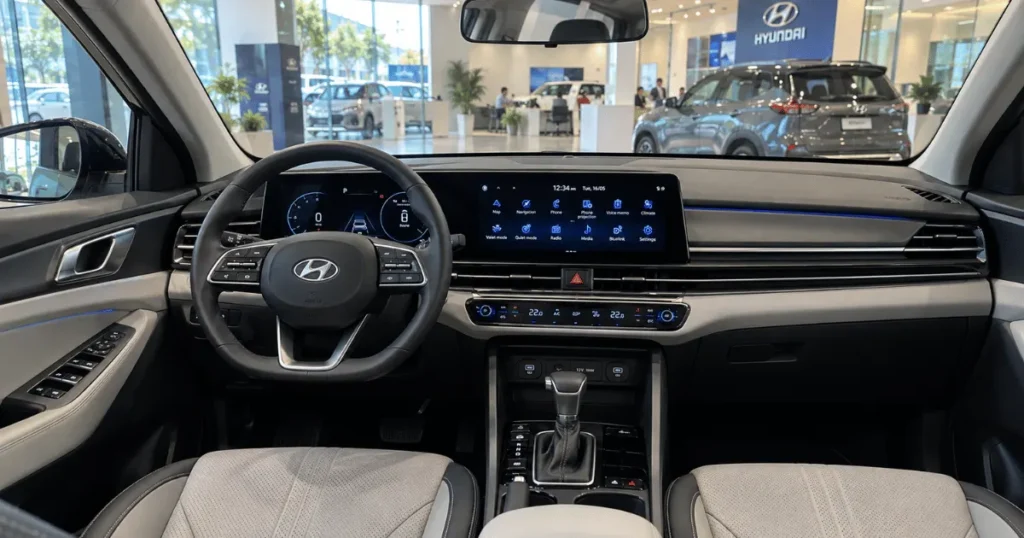
The Hyundai Bayon SUV features dual 12.3-inch curved panoramic displays, combining the digital instrument cluster and infotainment functions in a connected cockpit layout.
Large screens can make navigation and vehicle information easier to view, but usability depends on the interface, screen responsiveness, menu structure and placement of frequently used controls.
During a showroom visit, check whether you can quickly find climate settings, audio controls and navigation without becoming distracted. Look at screen visibility in bright light and examine whether the display can be understood from your normal driving position.
The cabin’s physical practicality matters just as much. Check the front-seat adjustment range, rear-seat comfort, storage spaces, charging provisions and visibility through the windows. If children or older family members regularly travel with you, ask them to sit in the back before you decide.
What to do: Spend time operating the screens in the stationary vehicle. Do not judge cabin quality from promotional photographs alone.
5. Find Out How the AI Voice Assistant Works
Hyundai is promoting a generative AI voice assistant that uses intelligence from Perplexity and voice AI powered by SoundHound AI. The system is intended to support more natural interactions and provide real-time assistance.
The useful question is not simply whether the car has AI. It is which everyday tasks the system can perform reliably, how quickly it responds and what happens when the internet connection is weak.
Hyundai also says the vehicle supports more than 500 embedded voice commands in English, Hindi, Hinglish, Tamil, Bengali and Telugu. Its infotainment and instrument-cluster interfaces support multiple regional and international languages.
These features could make the cabin easier to use for drivers who prefer voice interaction. However, buyers should distinguish embedded commands from cloud-dependent AI functions. Their availability, response quality and data requirements may differ.
What to do: Ask the dealer to demonstrate the actual India-spec system. Test common requests, supported languages and navigation functions rather than relying on a general feature description.
6. Verify Connected Features, Updates and Ownership Costs
Hyundai has announced more than 70 Bluelink connected features and over-the-air updates for up to 19 vehicle controllers. The connected-car navigation cockpit is accelerated by NVIDIA technology.
Software updates can help a vehicle’s systems evolve after delivery, but the ownership experience depends on how the features are delivered and maintained. Some connected services may require an active subscription, mobile connectivity or compatible devices.
Before booking, ask which functions are included with the vehicle, how long any complimentary service period lasts and what renewal charges may apply. Confirm whether remote features work with your smartphone and whether the vehicle requires a particular mobile network or app configuration.
Also ask the service team how software updates are installed, whether the vehicle needs to be parked during an update and how updates are handled if an installation fails.
What to do: Request the latest connected-feature list and subscription terms in writing. Confirm whether the features you value are available on your chosen variant.
7. Check Safety Equipment and Practical Family Needs
Technology and design should not distract from the basics of family-car ownership. Before choosing the Hyundai Bayon SUV, verify the standard safety equipment on each variant.
Ask for the final India-spec details covering airbags, electronic stability control, parking sensors, rear-view camera, child-seat anchorages and driver-assistance systems. Do not assume that every feature available in another country will be offered in India.
The same caution applies to boot capacity, rear-seat space, ground clearance and spare-wheel arrangements. These details affect daily use, especially for households that regularly travel with luggage or encounter uneven roads.
If the SUV will be used for long journeys, check rear-seat comfort, cabin noise, lighting, tyre specifications and the availability of assistance in your area. A well-equipped cabin is valuable, but it cannot compensate for a poor fit with your family’s actual needs.
What to do: Obtain the official India variant brochure when it becomes available. Verify the equipment list and, where relevant, consult independent crash-test information for the exact model and market.
Hyundai Bayon SUV: What Buyers Should Wait to Learn
The official reveal establishes the main engine and technology details, but several purchase-critical questions remain open until Hyundai releases its complete launch information.
| Information to confirm | Why it matters |
|---|---|
| Variant-wise prices | Helps establish value for money |
| Certified fuel efficiency | Supports running-cost estimates |
| Full safety equipment | Reveals what is standard and optional |
| Dimensions and boot space | Helps assess parking and family practicality |
| Warranty and service terms | Affects long-term ownership costs |
| Connected-service subscription details | Shows the ongoing cost of digital features |
| Delivery timelines | Helps buyers plan their purchase |
Buyers should avoid treating unconfirmed estimates as final specifications. The final brochure, price list and dealership quotation will provide a more reliable basis for comparison.
CarBike Insight Analysis
The Hyundai Bayon SUV arrives with a clear technology-led pitch. Its confirmed 1.5-litre petrol engine gives buyers a straightforward starting point, while the dual-screen layout, connected services and generative AI voice assistant distinguish its announced equipment package.
But a modern interface does not automatically make a vehicle a better purchase. The final price, variant distribution, comfort, fuel efficiency and safety equipment will determine whether the Bayon offers a convincing overall package.
Buyers should also think about how they use their cars. Someone who spends most of the day in city traffic may value the IVT and easy-to-use cabin more than a long feature list. A family that frequently travels outside town may place greater importance on rear-seat comfort, luggage capacity, highway refinement and service access.
The most sensible approach is to wait for the full price list, compare equivalent variants and take a proper test drive before committing.
Final Takeaway
The Hyundai Bayon SUV is a new option worth evaluating, particularly for buyers who want a petrol-powered vehicle with a modern digital cabin and connected features. Hyundai has confirmed the key engine outputs, transmission choices and major technology highlights, but the final value-for-money judgement must wait for pricing and the complete India-spec equipment list.
For now, focus on the details that affect daily ownership rather than booking solely because of the launch buzz. Once official prices and variant information are available, buyers will be in a much stronger position to decide whether the Bayon deserves a place on their shortlist.
Information checked against Hyundai Motor India’s official announcement. Launch timing, equipment and prices may change. Confirm final details with Hyundai before purchasing.
- Toyota Innova Flex Fuel: Gadkari’s Nov 26 Date and ₹25 Claim Checked
- Triumph Tiger 900 2027: Radar Teased at EICMA; Specs Due Dec 15
- Italjet Dragster 459: Twin Scooter Bound for India Bike Week 2026
- KTM 1390 Super Duke GT EVO: Clutchless AMT Sport-Tourer Revealed
- VOGE Sfida SR16 380: 40.1 hp 16-Inch Scooter Unveiled at EICMA