The Xpeng G9L Europe launch brings a new large electric SUV into a market where buyers increasingly expect more than impressive battery specifications. Space for the family, dependable charging, practical luggage capacity and convenient daily driving can matter just as much as acceleration or touchscreen technology.
Xpeng has introduced the G9L to European audiences at the 2026 Paris Motor Show. The electric SUV measures 5,120mm long and has a 3,100mm wheelbase. European versions are offered with six- or seven-seat configurations, positioning the vehicle as a larger alternative to conventional five-seat electric SUVs.
The vehicle also combines a 106.7kWh battery, an 800V electrical architecture and rear-wheel steering. Xpeng says the G9L will be produced at Magna’s facility in Graz, Austria, making it the fourth Xpeng model assembled at the site.
These specifications make the G9L worth examining, but they do not automatically establish whether it is the right electric SUV for every household.
Here are seven practical considerations buyers should evaluate before placing an order.
1. Xpeng G9L Europe Launch: Does Its Large Cabin Justify the Size?
The Xpeng G9L is designed for buyers who need more passenger space than a typical five-seat electric crossover provides.
Its 5,120mm length and 3,100mm wheelbase indicate that cabin packaging is central to its proposition. The European model offers six- and seven-seat arrangements, giving buyers different ways to configure the passenger compartment.
However, a long body does not guarantee that every seat is equally comfortable.
Families should examine the vehicle with the number of passengers they expect to carry regularly. A six-seat layout may offer a different balance of access and personal space from a seven-seat configuration.
Third-row access deserves particular attention. Buyers should check whether passengers can enter and leave without repeatedly moving child seats or folding the front seats.
Seat comfort also depends on legroom, headroom, seat cushioning and the position of the floor. These details become more important during long journeys than during a short showroom visit.
Luggage space is another consideration. A vehicle can accommodate seven people while offering less room for suitcases when every seat is occupied.
The G9L has a reported 466-litre rear luggage compartment and an additional 109-litre front storage compartment. Buyers should confirm how the rear luggage capacity changes with the third row in use.
CarBike Insight recommendation: Inspect the exact seating configuration you intend to purchase. Do not assume that the six-seat and seven-seat versions offer identical passenger access or luggage flexibility.
2. Can the Xpeng G9L Handle Everyday Parking?
Large electric SUVs often promise generous interior space, but their dimensions can make everyday manoeuvres more demanding.
The G9L’s length exceeds five metres, which may be inconvenient in older European city centres, underground parking garages and residential buildings with compact parking spaces.
The vehicle does have one feature intended to help. Its rear-wheel-steering system allows the rear wheels to turn, improving manoeuvrability at low speeds. CarNewsChina reports a turning radius of less than 5.5 metres.
This could be useful when negotiating tight corners or entering a narrow parking space.
However, rear-wheel steering does not make a large vehicle physically smaller. The driver’s visibility, parking-camera quality, turning behaviour and overall width will still influence the experience.
Before purchasing, check the dimensions of your regular parking space against the vehicle’s official measurements. Include the space required to open doors and access the boot.
A test drive should also include tight turns and low-speed manoeuvres where possible.
Buyers who regularly travel through narrow streets should assess these factors before becoming attracted to the G9L’s cabin technology or powertrain.
For households with private driveways and larger parking spaces, the vehicle’s size may be less of a concern. The same dimensions that complicate urban parking can help create a spacious passenger compartment.
3. What Does the 106.7kWh Battery Mean for Long-Distance Travel?
The European electric version of the Xpeng G9L uses a reported 106.7kWh nickel-manganese-cobalt battery pack.
CarNewsChina reports a WLTP range of 553km to 591km, depending on the drive configuration. These figures should be treated as manufacturer-reported specifications rather than guaranteed distances in everyday driving.
A large battery can make an electric SUV more convenient for intercity travel because it provides a substantial energy reserve.
Nevertheless, actual range depends on several variables.
Highway speeds increase energy consumption compared with slower driving. Cold weather, heating use, passenger load, road gradients and wheel specifications can also affect efficiency.
A family planning regular motorway journeys should therefore consider a realistic travel range rather than assuming the maximum advertised figure will always be achievable.
For example, someone travelling between cities should identify charging stations along the intended route and allow for a reserve before reaching the next stop.
The vehicle’s powertrain choice matters as well. The reported European specifications include rear-wheel-drive and all-wheel-drive versions, with different performance and range figures. The rear-wheel-drive version is reported to reach 100kmph in seven seconds, while the all-wheel-drive version takes 4.9 seconds.
Buyers should compare the final homologated figures for the exact model they plan to order.
The key question is not whether the G9L has a large battery. It is whether its real-world range and available charging infrastructure fit your regular journeys.
4. Is the Xpeng G9L’s Fast Charging Useful Outside a Demonstration?
Xpeng’s G9L uses an 800V electrical architecture, and CarNewsChina reports a charging time of approximately 12 minutes to reach 80%.
That is an impressive headline figure, but charging performance depends on the vehicle’s supported charging power and the equipment available at the charging station.
Drivers should not assume that every public charger will deliver the maximum advertised performance.
The charging station must support the required power level, and the battery must be within suitable operating conditions. Charging speed can also change as the battery approaches a higher state of charge.
For long-distance travel, the difference between a vehicle’s theoretical charging time and a complete stop can be significant.
Drivers still need to reach the station, connect the vehicle, complete any required payment process and rejoin the route.
A compatible high-power charger along a regular motorway route could make the G9L more convenient. A slower charger at a destination may reduce that advantage.
Before ordering, buyers should identify the charging networks available in their country and check the vehicle’s supported charging standards.
Home charging should also be part of the calculation. A household with a suitable private charging installation may rarely need public fast charging during the working week.
For buyers who depend entirely on public chargers, network coverage and pricing may matter more than the fastest charging figure in the brochure.
The final European charging specifications and independent tests will provide a stronger basis for assessing the G9L’s real-world performance.
5. Do the Screens and Connected Features Improve Ownership?
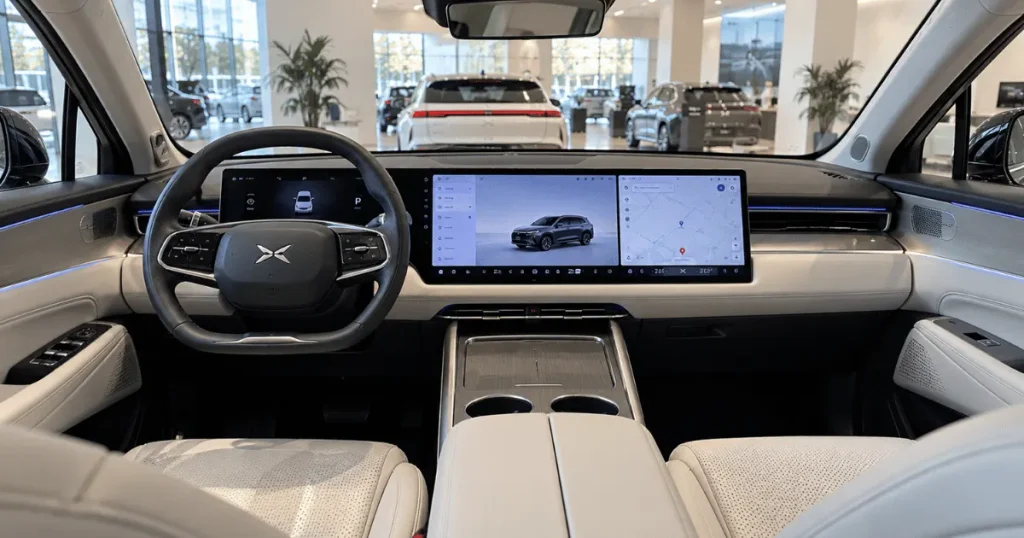
The G9L takes a technology-focused approach to the electric SUV interior.
Its reported equipment includes an 8.8-inch instrument display, a 17.3-inch central touchscreen, a 21.4-inch ceiling-mounted screen and an eight-inch rear control display. The vehicle also includes an augmented-reality head-up display and integrated Google Maps, according to CarNewsChina.
These features could appeal to families who want navigation, entertainment and vehicle information integrated into the cabin.
However, the quality of the experience depends on how easily the systems work together.
Drivers should establish whether essential functions can be accessed without navigating through multiple menus. Frequently used controls should be easy to operate without distracting the driver.
The availability of connected services also matters. Buyers should ask which functions require an internet connection, whether subscriptions apply and how software updates are delivered.
Rear-seat entertainment can be useful for families, but it should not be the deciding factor in a vehicle purchase. Seat comfort, cabin noise, air-conditioning performance and passenger access remain important.
The G9L also has a reported 12.5-litre built-in refrigerator. This could be convenient for long trips, although its practical value will depend on usable storage space and the effect of the feature on cabin packaging.
Prospective buyers should test the actual European specification rather than assuming that every feature shown in promotional material will be standard in every market.
6. What Should Buyers Know About Local Production and After-Sales Support?
Xpeng has confirmed that the G9L will be produced at Magna’s facility in Graz, Austria.
The vehicle follows the G6, G9 and P7+ as the fourth Xpeng model associated with production at the site. Xpeng says the arrangement forms part of its European manufacturing strategy. XPENG
Local production can support a manufacturer’s regional operations, but it does not automatically guarantee lower prices, faster repairs or better parts availability.
Those outcomes depend on the supply chain, production volumes, distribution arrangements and service network.
Buyers should therefore investigate the ownership support available in their country.
Questions worth asking include:
- Where is the nearest authorised service centre?
- How long is the vehicle warranty?
- What battery warranty applies?
- How are software and electronic-system faults handled?
- Are replacement parts stocked locally?
- What is the expected waiting time for routine servicing?
- Does roadside assistance cover long-distance travel?
These details can influence ownership satisfaction for years after the initial purchase.
A premium electric SUV contains complex electronic systems and high-voltage components. Access to trained technicians and suitable diagnostic equipment is important.
The manufacturer’s European production arrangement is a useful development, but customers should assess the actual support network available to them rather than treating the location of the factory as proof of service quality.
7. Is the Xpeng G9L Worth Its European Price?
The Xpeng G9L has entered the European market with prices that vary by country.
CarNewsChina reports a starting price of €74,990 in France, €74,600 in Germany and €75,600 in Austria. It also lists different prices for the Netherlands, Belgium, Norway, Denmark and Sweden.
Xpeng’s Austrian announcement confirms an initial recommended price of €75,600, including 20% VAT. The company also states that the vehicle’s consumption and emissions figures remain subject to final WLTP homologation. XPENG Newsroom
These prices place the G9L in the premium electric SUV category.
Buyers should compare more than the advertised starting price. The final cost can depend on seating configuration, equipment, delivery charges, local taxes and available incentives.
Insurance costs also deserve attention. A large, powerful electric SUV may have different insurance requirements from a smaller family vehicle.
Charging expenses can vary significantly depending on whether the owner uses home electricity, public AC chargers or high-power DC stations.
Potential buyers should calculate their expected annual mileage and compare the cost of charging with their current vehicle’s fuel expenses.
Depreciation is another unknown. A newly introduced model may not have an established used-car market, making future resale values difficult to predict.
For buyers keeping a vehicle for many years, the quality of the warranty and the long-term availability of parts may be more important than a small difference in the initial price.
The G9L could appeal to households seeking a spacious, technology-focused electric SUV, but its value will depend on the final specification and ownership costs in each market.
CarBike Insight Analysis: Space and Support Matter More Than Headline Figures
The Xpeng G9L combines a large battery, three-row seating options, fast-charging technology and a substantial collection of digital features.
Those characteristics give it a clear identity in the premium electric SUV market. Yet the most important ownership questions concern how the vehicle works in daily life.
Families need to know whether all passengers can travel comfortably, whether the luggage compartment remains useful with every seat occupied and whether the vehicle fits their parking arrangements.
Long-distance drivers need to understand the gap between official range figures and the distances they can realistically cover in different conditions.
The charging system also needs to be considered alongside local infrastructure. A fast-charging vehicle is most useful when compatible chargers are available along the routes its owner regularly travels.
Finally, service support will influence the experience after the initial excitement of a new vehicle wears off.
Xpeng’s European production plans are a relevant development, but the availability of local technicians, spare parts and warranty support should be checked separately.
Independent road tests and long-term owner reports will be particularly valuable as more vehicles reach customers.
For now, buyers should treat the G9L as an interesting new option rather than assuming its specifications automatically make it the best choice in its price category.
Final Takeaway
The Xpeng G9L Europe launch introduces a large electric SUV with six- and seven-seat configurations, a reported 106.7kWh battery and an 800V electrical architecture.
Its size and equipment could make it attractive to families seeking a spacious premium EV. However, real-world range, charging access, parking convenience and local after-sales support will determine how well it suits individual buyers.
Before ordering, compare the exact seating configuration, obtain a complete local price quotation and check the charging and servicing options available in your area.
The smartest purchase is not necessarily the electric SUV with the biggest battery or the most screens. It is the one that fits your everyday requirements without creating unnecessary ownership costs.
- Volkswagen Virtus Facelift: First Teaser Shows New Lights Before December
- Mahindra Q2 FY27 Results: Profit Up 25% as SUV Volumes Jump 26%
- Xpeng Mona L05: Deliveries Start With a 10,000-Unit Month Target
- Altigreen Minsara: Multi-Utility Electric Motorcycle From ₹1.24 Lakh
- BYD Seal 07 Gen 2: China Launch Day Brings 875 km Blade Battery Sedan