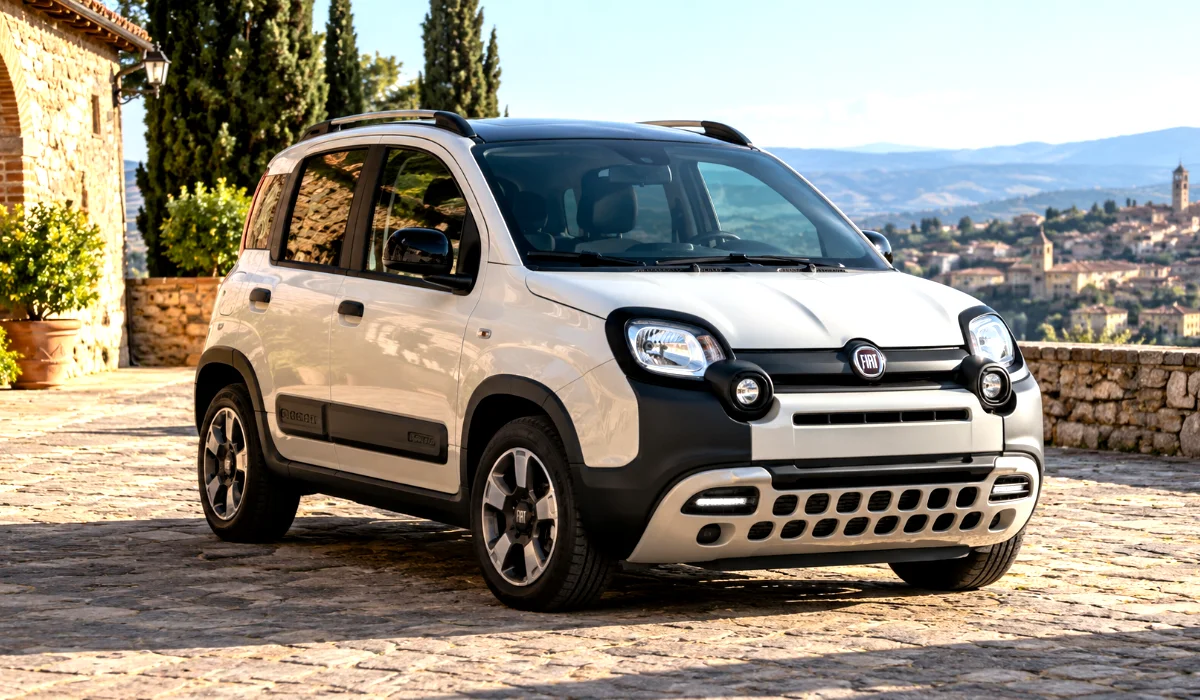
Fiat Pandina Tributo Autobianchi gives a familiar small hatchback a carefully chosen piece of Italian motoring history. Revealed on October 21, the new top-range version marks 30 years since the last Autobianchi Y10 was registered and links that compact luxury-minded car to the Fiat Panda family from which it drew its platform roots.
This is a special edition built around design and heritage, not a new-generation car. Fiat says it joins the existing Pandina Pop, Icon and Cross trims, all of which are available with a hybrid powertrain. The company has not announced a new engine or a mechanical upgrade for the Tributo Autobianchi.
The special edition’s visual changes are more than a badge. Fiat lists an exclusive Platino body colour, black contrasting details, a black tailgate on the two-tone version, 15-inch diamond-cut alloy wheels and dedicated Tributo Autobianchi personalisation. Inside, the cabin gets light sand-coloured finishes and seats with a distinctive checked pattern and dedicated logo details.
Why the Autobianchi connection matters
Autobianchi was known for compact cars that offered more visual polish than their size might suggest. Fiat’s announcement positions the Y10 as a small car with sophisticated styling and refined finishes, based on a platform related to the Panda. The Pandina tribute borrows that idea: it retains a practical city-car base but uses materials, colours and details to make the car feel more individual.
The date is part of the story. Fiat says the first Pandina Tributo Autobianchi produced was registered on October 21, 2026, exactly 30 years after the last Autobianchi Y10. That is a symbolic connection rather than a claim that the new car mechanically recreates the Y10.
The Y10’s legacy is useful to understand the edition, but buyers should keep expectations grounded. There is no return of the Autobianchi brand or a separate new model line in Fiat’s announcement. The name appears as a tribute applied to a special Pandina specification.
Exterior and interior changes
The exclusive Platino paint provides the clearest visual distinction. Fiat also offers black contrasting details, including a black tailgate and roof on the two-tone version. The 15-inch diamond-cut alloys and dedicated badges complete the outside treatment.
The interior aims for a lighter, more tailored atmosphere. Fiat describes sand-coloured seats with a checked motif and logos on the front headrests, along with coordinated door-panel and dashboard finishes. These choices are likely to appeal to buyers who want a small car that feels less utilitarian without moving into a larger or more expensive class.
The practical question is whether the special-edition equipment justifies its eventual price premium. Fiat has not published a price in the English-language press release cited here, so a precise comparison cannot yet be made. Buyers should compare the trim against the regular Pandina Cross, check what is standard versus optional, and consider whether the materials are easy to keep clean in daily use.
Core Elements of Detailed Mechanical Specifications
| Specification area | Confirmed information |
|---|---|
| Vehicle type | Special edition of the Fiat Pandina |
| Position in range | Top of the Pandina line |
| Powertrain | Existing hybrid motorisation; no new engine announced |
| Plant | Pomigliano d’Arco, Italy |
| Exterior updates | Platino colour, black accents, dedicated badging |
| Wheels | 15-inch diamond-cut alloy wheels |
| Interior updates | Sand-coloured finishes and checked seat pattern |
| Price and full output data | Not included in the cited announcement |
Fiat’s release does not set out a new performance figure, battery size, transmission revision or chassis change. Those should not be inferred from the special edition’s name or appearance. For full engine and homologation data, buyers should refer to the local Pandina technical sheet.
Is the Pandina still a practical city car?
Fiat says the Pandina retains the qualities behind its sales performance: simplicity, practicality, accessibility and versatility. The company also reports 100,000 European registrations in the first nine months of 2026, a 7% rise, and 86,000 registrations in Italy, up 5%. These are manufacturer figures and help explain why Fiat is extending the range with a premium-looking variant rather than replacing the car outright.
For city use, a compact footprint and hybrid assistance can make more sense than a large battery-electric vehicle for drivers without reliable home charging. But buyers need to assess the actual driving pattern. A mild-hybrid system is not the same as a plug-in hybrid or a battery EV, and it cannot be assumed to deliver electric-only commuting.
The special-edition cabin may make the car more appealing to a buyer who values design, but it does not change the basic trade-offs of a small hatchback: rear-seat room, luggage space, highway refinement and safety equipment should be checked against the buyer’s needs.
What the sales figures tell us
Fiat’s reported European and Italian registration totals help explain why it is continuing to invest in the Pandina name. The company says the model ranked first in Europe’s A segment during the first nine months of 2026 and remained Italy’s best-selling car. Those are manufacturer figures, and they should be read as a snapshot of the period rather than a guarantee of future demand.
The figures also show why special editions are useful to a manufacturer. A new paint scheme and cabin treatment can create fresh showroom interest without the cost and complexity of a full redesign. That can keep a model visible while a company develops its next generation or adapts production. For consumers, the benefit is greater choice; the trade-off is that a special edition may cost more without changing core capability.
The ownership value depends on the price gap and resale demand. A distinctive edition can be desirable to some future buyers, but special-edition badges do not automatically preserve value. Customers should compare the on-road cost with an equivalent regular trim and consider whether the unique upholstery, wheels and paint are worth the difference to them personally.
The small-car experience buyers should assess
The Pandina’s strongest case is likely to be urban practicality: a compact footprint, straightforward controls and a hybrid-assisted powertrain. Buyers should still sit in the rear seats, load the boot with their regular bags and test the car over the roads they use. The visual treatment cannot answer questions about seat comfort, cabin noise, visibility or suspension behaviour on broken surfaces.
Safety equipment deserves equal attention. Buyers should compare the exact local trim’s active and passive safety features, not assume all versions have identical equipment. Driver-assistance systems can vary by market and model year. The published specification sheet and a dealer demonstration are more useful than a general description of the range.
For drivers who park on narrow streets or make short daily trips, a small hatchback may be more convenient than a larger SUV. For regular motorway travel or family use, rear-seat space, luggage capacity and high-speed refinement could matter more. The right choice depends on routine, not on the special edition’s heritage story alone.
CarBikeInsight Analysis
The Tributo Autobianchi edition works because its reference point is specific. Rather than adding generic black trim and calling the car a special model, Fiat has tied the colours and interior pattern to a recognisable chapter in its own history. That gives the edition a story buyers can understand.
The commercial case will depend on the price and equipment. A carefully finished small car can feel special without needing a larger engine, but a high premium would be harder to justify if the changes are mostly cosmetic. The key comparison is with the regular Pandina trims and the equipment they already include.
The edition also says something about the small-car market. Manufacturers can keep an established compact model relevant by refreshing its presentation, especially when demand remains strong. That strategy is credible if Fiat continues to support the car’s safety, efficiency and serviceability. It becomes less convincing if the heritage name is asked to carry a price jump without meaningful ownership value.
For now, the confirmed changes are styling and cabin details, with the existing hybrid range retained. Fiat has not announced an India launch or India price. Treat the Pandina Tributo Autobianchi as a European-market special edition unless the company confirms a wider rollout.
-
Fiat Pandina Tributo Autobianchi revives a small-car design story
Fiat Pandina Tributo Autobianchi gives a familiar small hatchback a carefully chosen piece of Italian motoring history. Revealed on October 21, the new top-range version marks 30 years since the last Autobianchi Y10 was registered and links that compact luxury-minded car to the Fiat Panda family from which it drew its platform roots. This is…