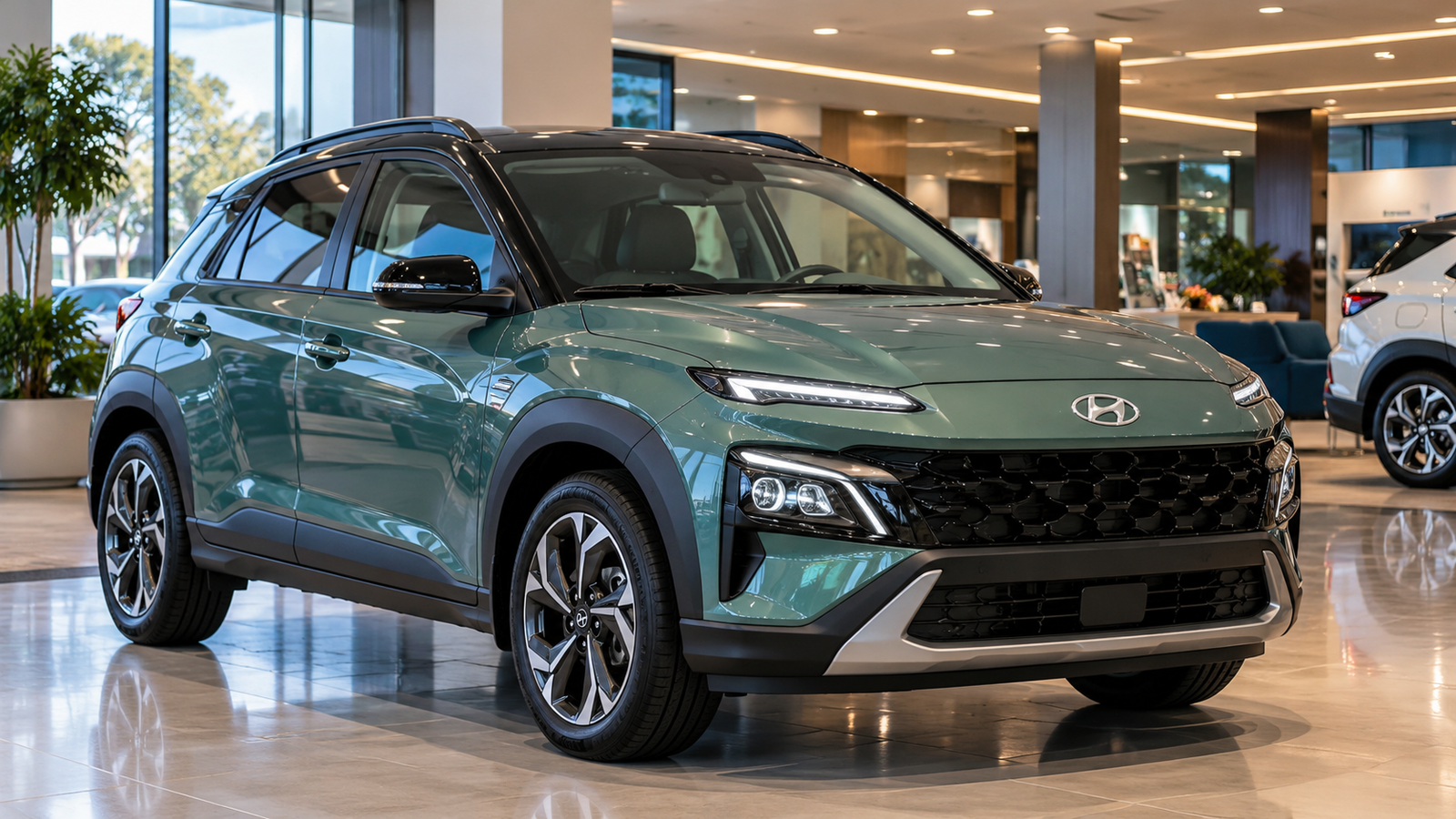
Hyundai Bayon India Launch: The Hyundai Bayon is due to launch in India on October 26, and its most distinctive talking point is not a new engine or an unusual body style. Hyundai is leading with software: the India-spec SUV is set to bring a generative AI voice assistant, a connected cockpit accelerated by NVIDIA technology, two 12.3-inch displays and over-the-air updates for as many as 19 vehicle controllers. That makes the Bayon one of the clearest signs that carmakers now see the cabin interface as a major part of the product, not a screen added after the mechanical decisions are made.
There is a useful counterpoint. Under the technology-heavy presentation sits a conventional 1.5-litre, four-cylinder naturally aspirated petrol engine. Hyundai says it produces 115PS and 144Nm, with a six-speed manual or Intelligent Variable Transmission. That combination may prove sensible for a family SUV used in mixed city and highway conditions. It also means the Bayon’s success will depend on how well the technology works in daily life, not on a headline-grabbing powertrain.
Hyundai has opened bookings for Rs 11,000 through its website and dealerships. Deliveries are planned for the festive period. Pricing, variant structure, fuel efficiency, dimensions and the complete safety equipment list remain details to verify at the launch. Buyers should treat online estimates as forecasts until Hyundai publishes the final price list.
Hyundai Bayon India launch: what the AI assistant can do
Hyundai says the Bayon will be its first Indian model with a generative AI voice assistant. The system combines intelligence from Perplexity with voice AI from SoundHound. In principle, a generative assistant can handle more natural requests than a menu-driven command system. Instead of memorising a precise phrase, a driver may be able to ask a question conversationally and get a context-aware response. But the company has not yet published a full list of supported questions, operating conditions or limits.
That caveat matters. A smart assistant in a vehicle needs to be predictable and quick, and it must not distract the driver. Hyundai says more than 500 embedded voice commands in English, Hindi, Hinglish, Tamil, Bengali and Telugu can perform common functions without an internet connection. This local command set may be more valuable in routine use than a cloud-based chatbot because climate, media and navigation controls should still respond where mobile data is unreliable.
The connected functions are separate from the embedded commands. Hyundai says Bluelink offers more than 70 connected features, while the ccNC system uses NVIDIA acceleration. That describes the underlying computing architecture, not an autonomous-driving capability. The Bayon should not be presented as a self-driving vehicle based on these claims. Driver assistance and infotainment remain distinct systems, and the driver continues to be responsible for controlling the car.
Screens, software updates and ownership questions
The dashboard brings two 12.3-inch displays together in a curved panoramic layout, linking the instrument cluster and infotainment interface. Large screens can make navigation and vehicle information easier to read, but the interface design is what determines whether they feel intuitive. Useful questions for the launch review include whether commonly used functions have direct controls, how much can be customised, whether the display remains legible in bright sunlight and what features require a paid subscription.
Hyundai also says the Bayon supports vehicle-controller over-the-air updates for up to 19 controllers. The ability to update software without a workshop visit can reduce friction when the manufacturer improves a feature or fixes a software issue. It does not mean every component is updated wirelessly, nor does it guarantee that future features will be free. Hyundai has not yet explained the update schedule, data requirements or long-term support policy for the India-spec model.
The car’s multi-language interface supports 10 regional and two international languages, according to the company. That broad language support could be a practical differentiator for households where the primary driver and other users prefer different languages. The quality of voice recognition in real traffic, with music and road noise in the background, remains something a launch-day demonstration and later owner experience will clarify.
Hyundai Bayon engine and transmission details
Hyundai has confirmed a 1.5-litre MPi petrol engine with 115PS and 144Nm. The manual gearbox will have six speeds, while the automatic choice is Hyundai’s IVT. An IVT is a type of continuously variable transmission; it changes its effective ratio rather than stepping through fixed gears in the same way as a conventional automatic. Its aim is usually smoothness and efficiency, though some drivers may prefer the more familiar shift feel of a torque-converter automatic or dual-clutch transmission.
The naturally aspirated engine’s output should be understood in context. It is not a turbocharged performance unit, and Hyundai has not positioned the Bayon as one. The question for buyers will be whether its throttle response and power delivery feel adequate with a full cabin, luggage and highway overtakes. The 6-speed manual may suit drivers who want more direct control, while the IVT could reduce effort in dense traffic. Fuel economy figures and test-drive impressions should be considered before making a value judgement.
Hyundai has not announced a CNG option in the confirmed October 12 release. Previous market speculation or reports about a CNG variant should not be treated as confirmed equipment. The company’s launch specifications will settle that point.
Core Elements of Detailed Mechanical Specifications
| Component | Confirmed India information | What remains to be checked |
|---|---|---|
| Engine | 1.5-litre four-cylinder MPi petrol | Exact variant calibration and official fuel-efficiency figure |
| Maximum output | 115PS | Performance under full passenger and luggage load |
| Peak torque | 144Nm | Torque delivery and mid-range response in a road test |
| Manual transmission | Six-speed manual | Variant availability and gear ratios |
| Automatic transmission | Hyundai IVT | Drive modes, manual simulation and real-world behaviour |
| Displays | Two 12.3-inch curved displays | Interface usability and feature-by-feature variant split |
| Software updates | OTA capability for up to 19 controllers, as stated by Hyundai | Update policy, connectivity requirements and support period |
Where the Bayon could fit in India
Hyundai describes the Bayon as an Intelligent Utility Vehicle, but its exact positioning relative to the Venue and Creta will be clearer after the price announcement. If it lands between them, Hyundai will need to explain why buyers should choose it over an established model with a familiar feature set. The AI assistant and larger displays are a clear answer for technology-minded customers. Space, rear-seat comfort, boot capacity, safety ratings and ownership costs will matter just as much to families.
Its most interesting product decision may be the contrast between a mature petrol powertrain and a newer digital experience. That can be a strength if the engine is smooth and dependable, and the software feels genuinely useful. It can become a mismatch if the technology dominates the brochure but proves awkward to use or carries unclear subscription costs. Buyers should test the voice assistant with ordinary requests, rather than relying only on a polished demonstration.
CarBike Insight Analysis
The Hyundai Bayon’s India launch is worth watching because it offers a preview of how mainstream cars may change: more of the distinction will come from software and interaction, while engines and gearboxes continue to use familiar hardware. Hyundai’s claims are unusually specific about language support, offline voice commands and the number of controllers that can receive updates. Those details give buyers concrete questions to ask and let us judge the technology after launch.
For now, we know the core mechanical package and the planned launch date. We do not yet know the price, full variant matrix, crash-test result, official efficiency, or which connected functions will need a data plan. The Bayon may become a compelling family SUV if it combines this digital ambition with good ergonomics and a competitive price. Until those pieces are disclosed, its AI story is a promising feature set, not a complete ownership verdict.
-
Hyundai Bayon India Launch: AI Cockpit Takes Centre Stage, But the Engine Stays Familiar
Hyundai Bayon India Launch: The Hyundai Bayon is due to launch in India on October 26, and its most distinctive talking point is not a new engine or an unusual body style. Hyundai is leading with software: the India-spec SUV is set to bring a generative AI voice assistant, a connected cockpit accelerated by NVIDIA…