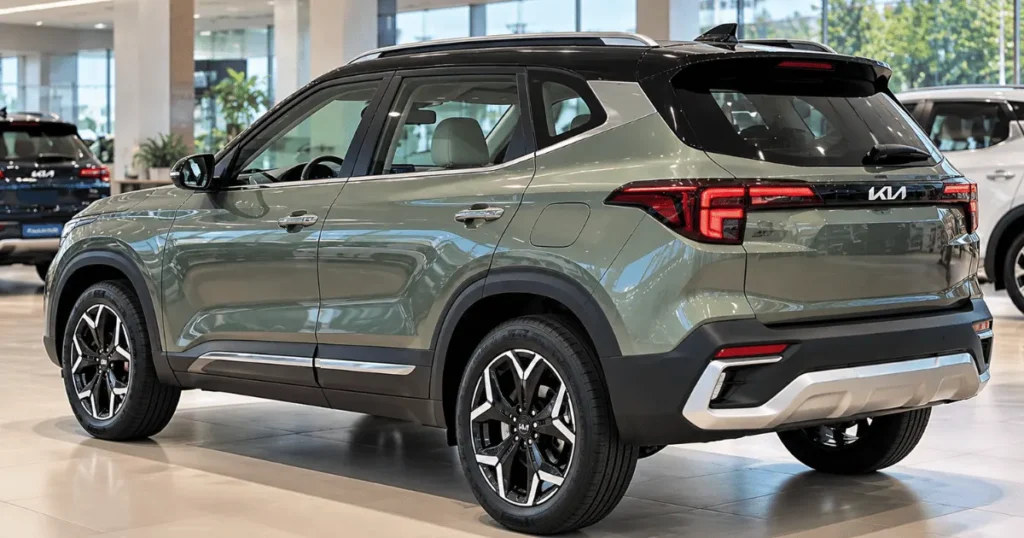
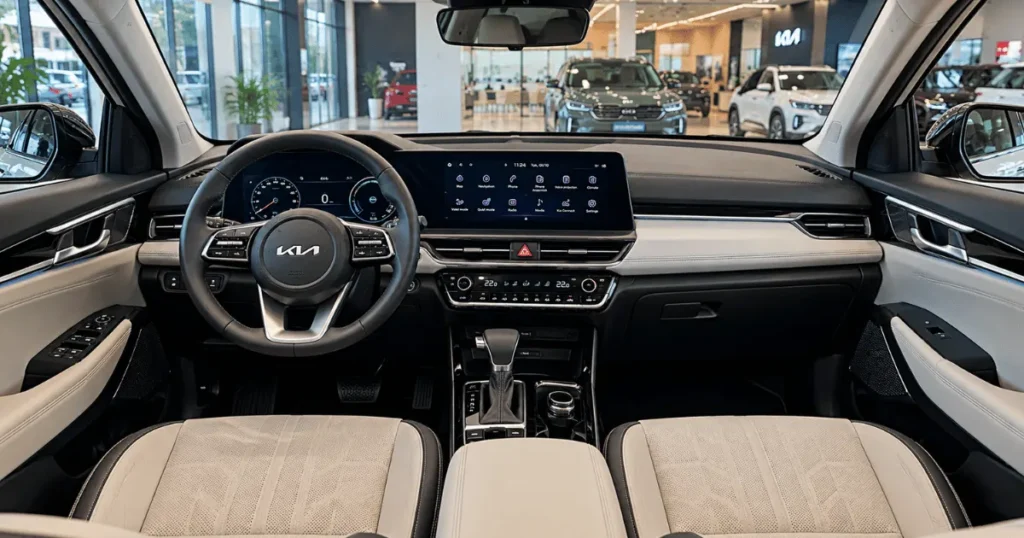
The Kia Seltos Hybrid may change how Indian buyers look at mid‑size SUVs. The Kia Seltos Hybrid is especially useful for people who spend hours in city traffic and want to cut fuel costs without buying a fully electric car.
Kia showed the Kia Seltos Hybrid at the 2026 Paris Motor Show adding powertrain choices worldwide. The Kia Seltos Hybrid is expected to arrive in India in 2027. The exact launch date, price and full details are not yet confirmed.
That gives buyers a dilemma. Should I buy a petrol or diesel Seltos now or wait for the Kia Seltos Hybrid to arrive?
The answer depends on more, than fuel efficiency. How far I drive each year my budget, my route and how long I plan to own the car will decide if waiting is a good money choice.
Here is another way to think about the Kia Seltos Hybrid before I buy my SUV.
Kia Seltos Hybrid: What Makes It Different?
The international Seltos Hybrid combines a petrol engine with electric assistance. Unlike a fully electric SUV, a conventional strong hybrid generally does not require external charging. The vehicle manages the interaction between its engine, electric motor and battery automatically.
According to international launch reporting, the showcased model uses a 1.6-litre petrol engine. The all-wheel-drive version has a reported combined output of 178hp, while a front-wheel-drive hybrid version has also been reported for selected markets. Kia has confirmed that the new Seltos Hybrid features its first e-AWD system.
These international details provide a useful preview, but Indian buyers should not assume the same configuration, equipment or fuel-efficiency rating will be offered locally.
| Buying factor | Existing Seltos petrol or diesel | Seltos Hybrid |
|---|---|---|
| Powertrain | Petrol or diesel engine | Petrol engine with electric assistance |
| External charging | Not required | Generally not required for a conventional strong hybrid |
| Purchase price | Check current India price list | India price not announced |
| Fuel efficiency | Depends on engine and driving conditions | India-specific figure not confirmed |
| Transmission | Varies by existing engine and variant | International versions use market-specific configurations |
| Best reason to consider it | Immediate availability and familiar choices | Potential efficiency benefits and electrified driving |
| India availability | Existing range is on sale | Expected in 2027, subject to official confirmation |
The comparison is about the buying decision, not a claim that the hybrid is automatically better than the current models.
1. Calculate Your Annual Fuel Spending Before Waiting
The first question is how much you actually spend on fuel.
A hybrid can reduce fuel consumption in suitable conditions, but the financial benefit depends on your current vehicle’s efficiency, the distance you drive and the price difference between the hybrid and a regular SUV.
Consider a simple illustration. Suppose you drive 15,000 kilometres annually. If your current SUV averages 12 kilometres per litre, it would consume approximately 1,250 litres of fuel each year.
If a future hybrid averaged 16 kilometres per litre under your actual driving conditions, it would consume around 938 litres over the same distance.
That would represent a saving of approximately 312 litres annually.
These figures are an illustration, not a prediction of the Seltos Hybrid’s Indian mileage. The actual result could be higher or lower depending on the vehicle, traffic, route and driving style.
| Illustrative scenario | Regular SUV | Hypothetical hybrid |
|---|---|---|
| Annual distance | 15,000 km | 15,000 km |
| Assumed efficiency | 12 km/l | 16 km/l |
| Annual fuel use | 1,250 litres | 938 litres |
| Approximate difference | 312 litres saved |
To calculate your own potential saving, divide your annual distance by the expected kilometres per litre, then multiply the difference in fuel consumption by your local fuel price.
The important point: A percentage improvement in mileage does not automatically mean a hybrid will be cheaper to own. Its additional purchase cost must also be considered.
2. Work Out How Long It Could Take to Recover the Price Premium
The hybrid’s Indian price is not confirmed, so it is too early to calculate an actual payback period. However, buyers can prepare a simple model before launch.
Imagine that a hybrid eventually costs ₹2 lakh more than a comparable regular SUV. If it saves ₹30,000 annually on fuel, it would take approximately 6.7 years to recover that extra purchase cost through fuel savings alone.
This example excludes financing interest, resale value, maintenance differences and changes in fuel prices. It is simply a way to understand the relationship between the initial premium and potential running-cost savings.
If you replace your car after three or four years, a large hybrid premium may be difficult to recover through fuel savings alone. If you keep your vehicle for a longer period and drive many kilometres every year, the calculation may be more favourable.
The result also depends on which existing variant you compare against. Comparing a hybrid with a much cheaper entry-level petrol model may exaggerate the price difference, while comparing equivalent equipment levels can provide a fairer picture.
What to do: Once Kia announces the Indian price, calculate the premium against the closest equivalent petrol or diesel variant. Do not rely on a general claim that hybrids always save money.
3. Decide Whether Your Driving Pattern Suits a Hybrid
Not all drivers benefit equally from hybrid technology.
Frequent stop-start driving can create opportunities for a strong hybrid to use electric assistance and recover energy through regenerative braking. That makes urban commuting a potentially attractive use case.
However, traffic conditions are only one part of the equation. Short journeys, air-conditioning use, steep inclines, passenger loads and driving speed can all affect consumption.
For someone who travels long distances on highways, the relative benefit may differ. At steady speeds, the petrol engine may do more of the work, and the hybrid’s efficiency advantage will depend on the system’s design and operating conditions.
Think about a normal week rather than an ideal journey. If most of your kilometres come from commuting through congested roads, a hybrid could be worth waiting for. If you drive only a few thousand kilometres annually, the fuel savings may not justify a substantial purchase premium.
A diesel model may also remain worth considering for buyers who regularly cover long distances, depending on local pricing, usage and ownership preferences.
What to do: Record your typical weekly distance and driving conditions. Use them as the basis for your future hybrid-versus-petrol calculation.
4. Consider the Risks of Buying Before the Hybrid Arrives
Waiting for a new powertrain offers potential benefits, but it also introduces uncertainty.
The India-spec Kia Seltos Hybrid may differ from the international vehicle in its engine configuration, drivetrain, equipment and fuel-efficiency rating. Even if the underlying technology is similar, market-specific changes can affect performance and value.
The final price could also influence the decision significantly. A hybrid that is competitively priced may appeal to many buyers, while a large premium could make an existing petrol or diesel version more attractive.
There is also the question of real-world testing. Early specifications can explain the vehicle’s design, but independent road tests will help reveal fuel consumption, refinement, transmission behaviour and everyday practicality.
Buyers who need a car immediately should not delay an essential purchase indefinitely based on an expected launch. If your existing vehicle is unreliable or your family needs more space now, a currently available model may be the more sensible choice.
What to do: Set a deadline for your decision. Wait for official Indian specifications if your purchase is flexible, but do not treat unofficial launch dates or estimated prices as guaranteed.
5. Compare Total Ownership Cost, Not Just Mileage
Fuel is a major ownership expense, but it is not the only one.
A meaningful comparison should include the purchase price, loan interest, insurance, scheduled servicing, tyres, warranty coverage and eventual resale value.
For the hybrid, buyers should pay particular attention to the warranty terms covering the battery and electrical components. Ask whether the warranty has separate time and distance limits, which exclusions apply and whether hybrid-specific repairs are covered by the standard service network.
Insurance quotations should also be checked for the exact variant. Do not assume the hybrid will cost the same to insure as a regular petrol model.
Resale value is another unknown. Hybrid demand may develop as more buyers become familiar with the technology, but future resale prices cannot be guaranteed today.
A useful comparison is to estimate your total cost over five years. Include the amount paid upfront, financing costs, fuel, servicing and insurance. If you expect to sell the vehicle sooner, use a shorter ownership period.
This approach provides a more realistic picture than choosing a car based on its claimed fuel efficiency alone.
Kia Seltos Hybrid: Who Should Wait and Who Should Buy Now?
The following guide can help you decide which path makes sense for your circumstances.
| Buyer profile | More sensible approach |
|---|---|
| High annual mileage with frequent city traffic | Wait for verified hybrid pricing and efficiency figures |
| Low annual mileage | Compare the hybrid premium carefully against a regular petrol SUV |
| Mostly highway driving | Evaluate independent hybrid tests and compare diesel options |
| Needs a car immediately | Consider currently available models rather than relying on a future launch |
| Keeps cars for many years | Calculate long-term fuel savings and verify warranty coverage |
| Wants the latest powertrain technology | Wait for the Indian model and assess its final equipment |
These are starting points rather than universal rules. Your budget and actual driving conditions should determine the final decision.
CarBike Insight Analysis
The Kia Seltos Hybrid could give Indian buyers a useful alternative to conventional petrol and diesel SUVs. Its petrol-electric powertrain may be especially appealing to people who want to reduce fuel consumption without changing their refuelling routine.
But the biggest question is not whether a hybrid can be efficient. It is whether the eventual Indian version will deliver enough savings and practical benefits to justify its price.
The international reveal establishes the direction of Kia’s hybrid strategy, while the India-specific price, specifications and efficiency figures remain the details buyers need most. Those figures will determine whether the hybrid is an attractive upgrade or a more expensive option that takes too long to justify financially.
For buyers who can wait, the smartest approach is to prepare a cost comparison now and update it when Kia releases official information. Buyers who need an SUV today should compare the available Seltos variants on their own merits.
Final Takeaway
The Kia Seltos Hybrid deserves attention, but waiting for it is not automatically the best decision for every Indian buyer.
If you drive long distances each year, spend considerable time in city traffic and intend to keep your SUV for several years, the hybrid could be worth evaluating once its price and efficiency are confirmed.
If your annual mileage is low, your budget is tight or you need a vehicle immediately, a regular petrol or diesel Seltos may remain the more practical option.
Make the decision using real fuel costs, the final price difference and your ownership plans. That is a more reliable strategy than buying into an expected mileage figure before the Indian model has been fully specified.
The hybrid’s India launch timing and specifications remain subject to official confirmation. International specifications and illustrative fuel calculations in this article should not be treated as guaranteed India-spec figures.
- Toyota Innova Flex Fuel: Gadkari’s Nov 26 Date and ₹25 Claim Checked
- Triumph Tiger 900 2027: Radar Teased at EICMA; Specs Due Dec 15
- Italjet Dragster 459: Twin Scooter Bound for India Bike Week 2026
- KTM 1390 Super Duke GT EVO: Clutchless AMT Sport-Tourer Revealed
- VOGE Sfida SR16 380: 40.1 hp 16-Inch Scooter Unveiled at EICMA