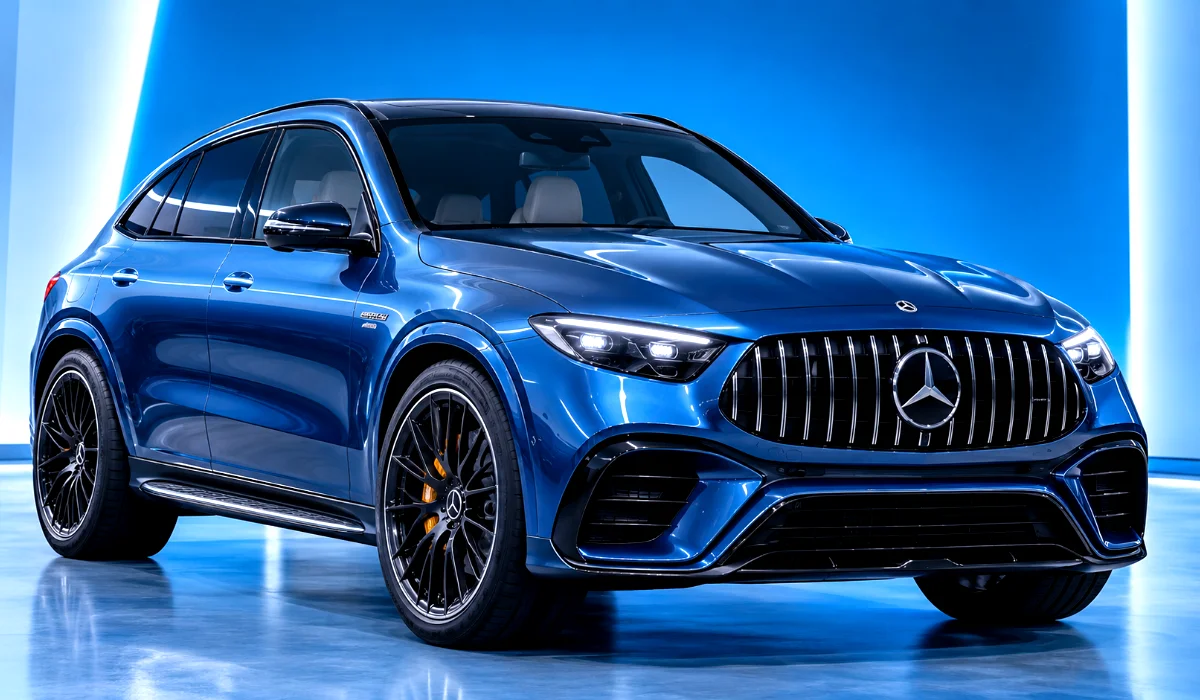
Mercedes-AMG has built its reputation around cars that make performance feel immediate and involving. Its new GT SUV takes that brief into full-size electric territory. The question is not simply whether it can accelerate like an AMG; the company’s published figures suggest it can. The harder test is whether its battery, motors, chassis and cabin can deliver that pace repeatedly while still making sense as an everyday SUV.
Unveiled on October 17, 2026, the Mercedes-AMG GT SUV is the first full-size SUV developed entirely in-house by AMG and the second model based on the AMG.EA high-performance architecture. The range is planned to include GT 53, GT 55 and GT 63 versions. Mercedes says the GT 63 will reach US dealerships in summer 2027; it has not announced India pricing or an Indian launch date in the material reviewed here. (Mercedes-Benz Media)
Here are five parts of the new SUV that deserve a closer look—and the questions the headline numbers cannot answer.
1. Three axial-flux motors give the GT 63 its performance headline
The GT 63 uses three axial-flux electric motors. Mercedes-AMG’s current model information lists up to 860kW, or 1,169hp, and a 0–100km/h time of 2.5 seconds. The official site also lists a 270km/h top speed with the optional Driver’s Package. These are manufacturer-published figures, and AMG says the range and performance values remain provisional pending certification.
Axial-flux motors are compact for the power they produce, which can help engineers package performance hardware in a vehicle with a tall body and room for passengers. But the motor layout is only part of the story. How the system manages power between the axles, and how quickly it responds when grip changes, will help determine whether the GT 63 feels precise or simply fast.
Mercedes says the range’s upper models use three motors, while the GT 53 uses two synchronous motors—one at each axle. The GT 53 is listed at up to 400kW (544hp). That gives the entry model a different mechanical setup, rather than just less output from the same hardware.
2. Sustained power may matter more than a single launch
A large electric SUV can post a startling acceleration time once. Repeating that performance is tougher. High power creates heat in the battery, motors and inverters; the car has to keep those components within a usable temperature range if the driver is to call on strong output again.
AMG says the GT 63 can provide 530kW of continuous output, supported by directly cooled cylindrical battery cells and a central cooling system. The company’s launch announcement describes the battery as an 800-volt design developed for repeatable power delivery. Those engineering claims address a real concern for high-performance EVs: what happens after the first hard acceleration or a sustained fast drive?
The road will provide the more useful answer. A performance SUV needs to manage heat not only during a short sprint, but also during repeated acceleration, steep climbs and hot-weather driving. Mercedes has described its approach; independent tests will show how consistently the car can deliver under different conditions.
3. Charging claims depend on the charger as well as the car
The GT 63 and GT 55 have a 128kWh battery, while the GT 53 uses a 106kWh unit, according to Mercedes. The company lists a maximum DC charging rate of up to 710kW for the larger-battery models and up to 600kW for the GT 53. Under ideal conditions, AMG says the GT 63 and GT 55 can add up to 450km of WLTP range in ten minutes; the GT 53’s stated figure is up to 440km.
Those are charging-curve claims, not a promise that any public charger will deliver that result. The station must support the required power, and the battery needs to be at a suitable temperature and state of charge. Mercedes lists roughly 12 minutes for a 10-to-80-percent charge on the GT 55 and GT 63. Actual times will vary with conditions and equipment.
For buyers, the practical question is where they can access compatible high-power charging. A very high peak rate is valuable on a suitable route, but charger availability, reliability and the car’s charging curve over a full stop matter just as much.
4. Active suspension has to reconcile SUV comfort with AMG response
Mercedes-AMG says the GT 63 comes with AMG ACTIVE RIDE CONTROL+ suspension, which actively counters body roll and pitch. The system is optional on the GT 55, according to the company. The SUV also uses active rear-axle steering and fully variable AMG Performance 4MATIC+ all-wheel drive. These systems are intended to help a large vehicle feel composed on a long trip and more responsive through corners.
That promise is ambitious. A high-riding vehicle carries its mass differently from a low sports car, and a heavy battery adds another challenge. Active suspension can control body movements, but the final experience depends on calibration: how the car reacts to bumps, how naturally it changes direction and whether the steering feels consistent across drive modes.
AMG also offers controls to tailor response, handling and traction. The settings may let owners adjust the car to a winding road, a wet commute or a more relaxed motorway journey. The important test is whether each mode feels meaningfully different without making the controls needlessly complicated.
5. It still has to work as a full-size SUV
The GT SUV is not being presented as a two-seat performance toy. Mercedes describes it as a full-size vehicle with a driver-focused front cabin and space for rear passengers. The company lists a 14-inch multimedia display and a 10.2-inch instrument display, alongside a panoramic glass roof. Its design pairs a low roofline and broad rear shoulders with the proportions needed for an SUV.
That mix raises practical questions. How easy is it to get into the rear seats? How much luggage fits behind them? Does the sloping roof reduce useful headroom? Mercedes has released cabin images and descriptions, but usable space is best judged in person, particularly for buyers who regularly carry adults or bulky luggage.
The sound experience also deserves context. AMG says its driving programme can reproduce the sound of a V8 in the GT 55 and GT 63, or a six-cylinder in the GT 53, with simulated gear changes and seat vibration. It is an attempt to give an electric drivetrain a more familiar performance character. Whether that feels engaging or artificial will be personal—and will require time behind the wheel to judge.
Core Elements of Detailed Mechanical Specifications
| Specification | Mercedes-AMG GT SUV information published by Mercedes |
|---|---|
| Architecture | AMG.EA high-performance electric architecture |
| GT 63 motors | Three axial-flux motors |
| GT 63 maximum output | Up to 860kW (1,169hp), manufacturer figure |
| GT 63 continuous output | Up to 530kW, manufacturer figure |
| GT 55 battery | 128kWh |
| GT 53 battery | 106kWh |
| GT 55 / GT 63 charging | Up to 710kW DC; up to 450km WLTP range added in 10 minutes, claimed |
| GT 53 charging | Up to 600kW DC; up to 440km WLTP range added in 10 minutes, claimed |
| GT 63 0–100km/h | 2.5 seconds, manufacturer figure |
| Suspension | AMG ACTIVE RIDE CONTROL+ standard on GT 63; optional on GT 55 |
| Drivetrain | AMG Performance 4MATIC+ fully variable all-wheel drive |
| Market timing | US dealership arrival stated for summer 2027; India timing and price not announced |
Mercedes notes that the published performance and range figures are provisional and may differ from certified values. The company’s material reviewed here does not establish India-specific pricing or availability.
CarBike Insight Analysis
The Mercedes-AMG GT SUV’s most interesting claim is not its 0–100km/h time. It is that a full-size electric SUV can deliver high output repeatedly, recharge quickly and still offer the comfort and space buyers expect from a vehicle of this size. AMG has put substantial engineering behind that ambition: three motors in the top models, an actively cooled 800-volt battery system, high charging peaks and suspension designed to manage body movement.
The numbers are impressive, but they are not the whole ownership story. Charging at the advertised peak requires compatible infrastructure. A 530kW continuous-output claim needs real-world testing. And the SUV’s passenger space, ride comfort and controls must work as well on ordinary roads as they do in a launch presentation.
For now, the GT SUV looks like a serious attempt to give AMG’s electric architecture a more practical body. Its success will depend on whether it feels like a coherent SUV rather than a collection of extraordinary specifications. Road tests, certified figures, market pricing and local charging access will tell buyers more than the launch headline can.
-
Mercedes-AMG’s Electric GT SUV: Five Technologies That Have to Work on the Road
Mercedes-AMG has built its reputation around cars that make performance feel immediate and involving. Its new GT SUV takes that brief into full-size electric territory. The question is not simply whether it can accelerate like an AMG; the company’s published figures suggest it can. The harder test is whether its battery, motors, chassis and cabin…