The Skoda Slavia facelift vs Honda City contest is the sharpest choice in India’s midsize sedan class right now. Both cars were updated in 2026: Honda launched the refreshed City on 22 May, and Skoda priced the new Slavia on 6 October, with deliveries from the following week.
The Slavia bets on turbo-petrol punch and a lower price; the City on a strong hybrid and Honda Sensing driver assistance.
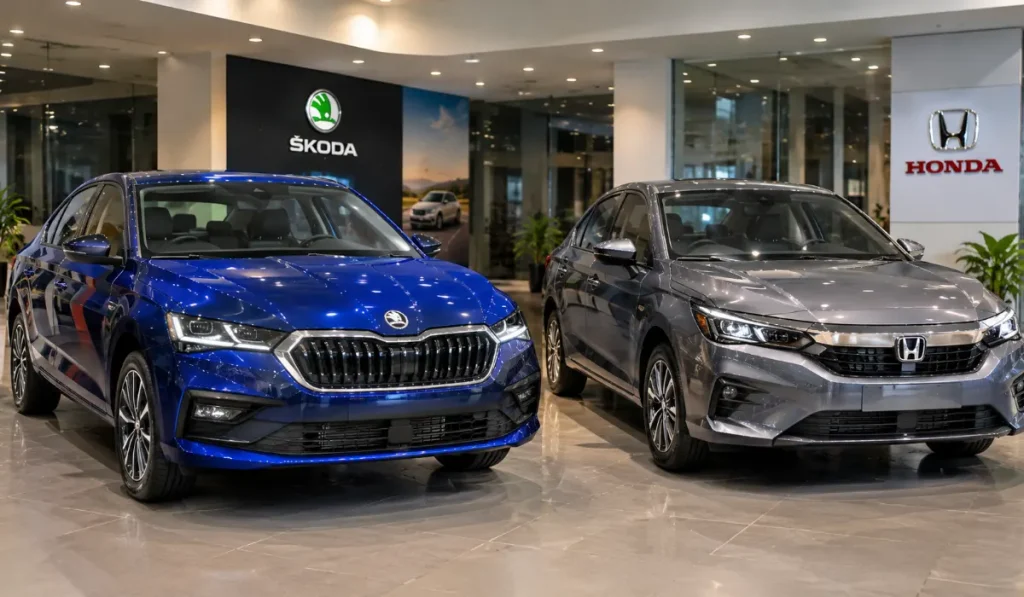
How much do the Skoda Slavia facelift and Honda City cost?
The new Slavia costs Rs 9.99 lakh to Rs 18.84 lakh ex-showroom across six trims. The City starts at Rs 11.99 lakh and, after Honda’s August 2026 increase, tops out at about Rs 21.36 lakh for the e:HEV hybrid. The Slavia is about Rs 2 lakh cheaper at entry and about Rs 2.5 lakh cheaper at the top.
At ECB reference rates of 13 November 2026 (Rs 94.24 per dollar), the Slavia spans about $10,610 to $19,990 (EUR 9,600-18,090; GBP 8,020-15,115). The City spans about $12,730 to $22,660 (EUR 11,520-20,505; GBP 9,625-17,135). These are Indian prices, not export prices.
Among automatics, Autocar India puts the gap at Rs 2.02 lakh at entry but only Rs 7,000 at the top.
What changed in the Slavia and City facelifts?
The Slavia gets new LED headlamps and tail-lamps with sequential rear indicators, new alloys, an eight-speed torque-converter automatic for the 1.0 TSI, rear-seat massage, a 360-degree camera and Google Cloud voice assistant. The City gets a sharper nose with a light bar, Z-shaped tail-lamps, a 10.1-inch screen, ventilated seats and a 360-degree camera.
Neither car changed its engines. Our 2026 Skoda Slavia update story has the trim-by-trim detail.
This is the second mid-cycle update of the fifth-generation City, not a new generation. The black City in recent comparison photos is this facelift, in the new Crystal Black Pearl paint.
Which is bigger, the Slavia or the City?
The City is longer, at 4,594 mm against 4,552 mm, but the Slavia has the longer wheelbase, 2,651 mm against 2,600 mm. The Slavia is also 4 mm wider and 18 mm taller. Its 521-litre boot beats the petrol City’s 506 litres, and the City hybrid gives up more space to its battery.
| Key fact | Skoda Slavia facelift | Honda City facelift |
|---|---|---|
| Launch | Prices 6 Oct 2026 | 22 May 2026 |
| Price (ex-showroom) | Rs 9.99-18.84 lakh | Rs 11.99-21.36 lakh (after Aug hike) |
| Engines | 1.0 TSI 3-cyl turbo, 115 PS, 178 Nm; 1.5 TSI 4-cyl turbo, 150 PS, 250 Nm | 1.5 i-VTEC, 121 PS, 145 Nm; 1.5 e:HEV hybrid, 126 PS, 253 Nm |
| Gearboxes | 6MT, 8AT, 7-speed DSG | 6MT, CVT, e-CVT |
| Claimed efficiency | 19.76 / 19.50 / 18.79 km/l | 17.77 / 17.97 / 27.26 km/l |
| Length / wheelbase | 4,552 / 2,651 mm | 4,594 / 2,600 mm |
| Boot | 521 litres | 506 litres (petrol) |
| Kerb weight | 1,175-1,271 kg | 1,123-1,294 kg |
| ADAS | None | Honda Sensing from V trim |
| Crash rating | Global NCAP 5 stars (2023) | No Bharat NCAP rating |
Skoda quotes 145 mm of laden ground clearance. Honda’s brochure lists no comparable figure, so we have not compared them.
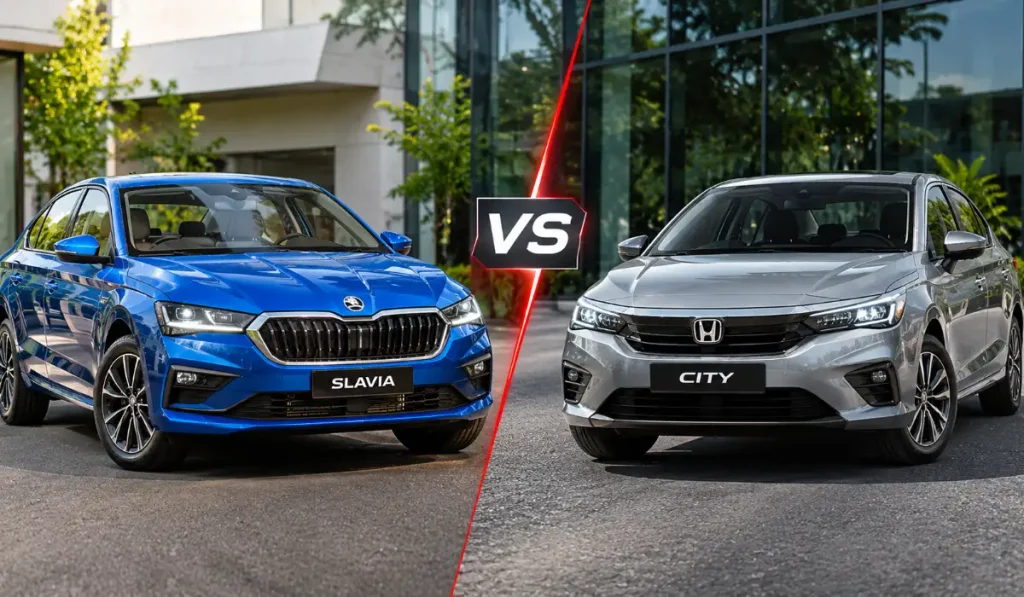
Which has better engines and mileage?
On paper the Slavia is quicker, with turbocharged engines making up to 150 PS and 250 Nm. In real-world testing the City is more frugal: Autocar India recorded 13.30 km/l for the City CVT and 12.06 km/l for the Slavia 1.0 eight-speed automatic. The City e:HEV claims 27.26 km/l, far ahead of any Slavia.
Autocar notes the Slavia was up to 90 kg heavier and tested in heat above 40 degrees Celsius. On paper, Skoda still claims more: 19.50 km/l against 17.97 km/l.
In Honda’s strong hybrid, a 109 PS motor drives the wheels most of the time while the 1.5-litre engine mostly generates power. Rivals are heading the same way, as Toyota’s next-generation 1.5-litre hybrid engine shows.
Which is safer, the Slavia or the City?
The Slavia has the stronger crash-test record: Global NCAP gave it five stars for adults and children in April 2023, scoring 29.71 of 34 and 42 of 49, and Skoda says the facelift carries that forward. The City has no Bharat NCAP rating, but it offers Honda Sensing ADAS, which the Slavia lacks.
Both cars have six airbags as standard. Honda Sensing on the petrol City brings collision mitigation braking, lane keeping and road departure mitigation from the V trim; adaptive cruise control is reserved for the e:HEV.
India is drafting mandatory automatic emergency braking rules for 2030 to 2032, and Bharat NCAP keeps adding results, such as the recent XUV 3XO CNG five-star rating.
Is the Honda City e:HEV worth the extra money?
Only for very high mileage, if you judge it on fuel alone. The e:HEV costs about Rs 4 lakh more than the City ZX+ CVT. Using claimed figures and Delhi petrol at Rs 102.12 a litre, our calculation shows you would need around 2.07 lakh km to recover that gap through fuel.
The hybrid also adds adaptive cruise, an electronic parking brake and rear discs. If you are weighing a hybrid, see our Kia Seltos hybrid wait-or-buy guide.
Where are the Slavia and City sold outside India?
The City is a global Honda sedan. Thailand got this facelift in June 2026 with a 1.0-litre turbo and the e:HEV, and Paul Tan reports Malaysia’s launched on 24 September. The Slavia is built in India on the MQB-A0-IN platform, and Skoda assembles it in Vietnam from Indian kits with partner Thanh Cong Group.
The Slavia’s twin, the Volkswagen Virtus, is next; its facelift teaser points to a December reveal.
What is confirmed and what is not?
Prices, engines, gearboxes, features, dimensions and the Slavia’s carried-over Global NCAP rating are confirmed by Skoda and Honda. Not confirmed: a Bharat NCAP rating for either car, ADAS for the Slavia, a City hybrid below the ZX+ trim, or any Slavia facelift timing for Vietnam.
| Claim | Status |
|---|---|
| Slavia Rs 9.99-18.84 lakh, 8AT for 1.0 TSI | Confirmed by Skoda, 6 Oct 2026 |
| City launch prices Rs 11.99-20.99 lakh | Confirmed by Honda, 22 May 2026 |
| City now up to about Rs 21.36 lakh | Reported by V3Cars and CarDekho; CarWale lists Rs 21.44 lakh |
| Slavia Global NCAP 5 stars carried forward | Skoda statement, based on 2023 test |
| Bharat NCAP rating for either car | Not tested |
| ADAS on the Slavia | Not offered |
| Real-world mileage 13.30 vs 12.06 km/l | Autocar India test, petrol automatics |
CarBike Insight Analysis
These cars overlap on price but not on purpose. Our calculations from official kerb weights: the Slavia 1.5 DSG makes about 118 PS per tonne against 97 for the City e:HEV, yet their torque per tonne is almost identical, about 197 and 196 Nm.
Using Autocar’s real-world figures and Delhi petrol at Rs 102.12, we estimate 10,000 km of fuel costs about Rs 84,700 in the Slavia 1.0 automatic and Rs 76,800 in the City CVT. On its claimed figure, the e:HEV would need about Rs 37,500.
Against the Slavia Monte Carlo 1.5 DSG, the e:HEV’s Rs 2.52 lakh premium takes about 1.49 lakh km to recover on claimed figures.
Our view: the Slavia is the better-value, better-crash-tested car for keen drivers, while the City suits buyers who want ADAS, low running costs and Honda’s resale strength. For India’s sedan class, holding off SUVs like Honda’s own Elevate facelift is the real test, and Volkswagen Group’s paused India EV plans mean these petrol sedans must carry Skoda for years yet.
See Skoda India’s official new Slavia launch release for the full trim and price list.
FAQ
Which is better, the Skoda Slavia facelift or the Honda City?
It depends on priorities. The Slavia is cheaper, more powerful and has a five-star Global NCAP rating. The City offers Honda Sensing ADAS, better real-world petrol efficiency in Autocar India’s test, and the only strong hybrid in the class.
Is the Skoda Slavia bigger than the Honda City?
Partly. The City is 42 mm longer overall, but the Slavia has a 51 mm longer wheelbase, is slightly wider and taller, and has a 521-litre boot against 506 litres for the petrol City.
Does the Skoda Slavia facelift get ADAS?
No. Skoda added a 360-degree camera, front and rear parking sensors and six standard airbags, but no ADAS. The Honda City offers Honda Sensing from its V trim, with adaptive cruise control on the e:HEV.
What is the mileage of the Slavia facelift and the City?
Skoda claims 19.76 km/l for the 1.0 manual, 19.50 km/l for the 1.0 automatic and 18.79 km/l for the 1.5 DSG. Honda claims 17.77 km/l manual, 17.97 km/l CVT and 27.26 km/l for the e:HEV hybrid.
Is the 2026 Honda City a new generation?
No. The car launched on 22 May 2026 is the second mid-cycle facelift of the fifth-generation City. It has a new face, tail-lamps and features, but the same 1.5 petrol and e:HEV hybrid powertrains as before.
- Nio Battery Swap Works at -48°C: What the Heihe Station Means for EVs
- Formula E GEN4: Mahindra M13Electro Revealed Ahead of Madrid Testing
- Hongqi EHS4 Arrives in Europe: Leapmotor-Based Electric SUV Debuts in Venice
- BYD Flash Charging: New Zealand Cars Due Early 2027, Chargers Come Later
- Kia Electrified Sales: 300,048 in Korea as EVs Pass 100,000 in One Year